Churen Trek

Confirmed Booked Group, You Can Join for 2026 & 2027 Know More

Everest Base Camp Trek – 16 Days

Duration

14 Days

Trip Difficulty

Moderate

Start/End Point

Kathmandu

Meals

Breakfast, Lunch, & Dinner

Max Altitude:

4,130m. / 13,550ft.

Group Size

2-15+ People

Best Season

Mar, Apri, May, Sep, Oct, Nov & Dec

Accommodation

3 Star Hotel in KTM / Lodge / Tea House during the Trek
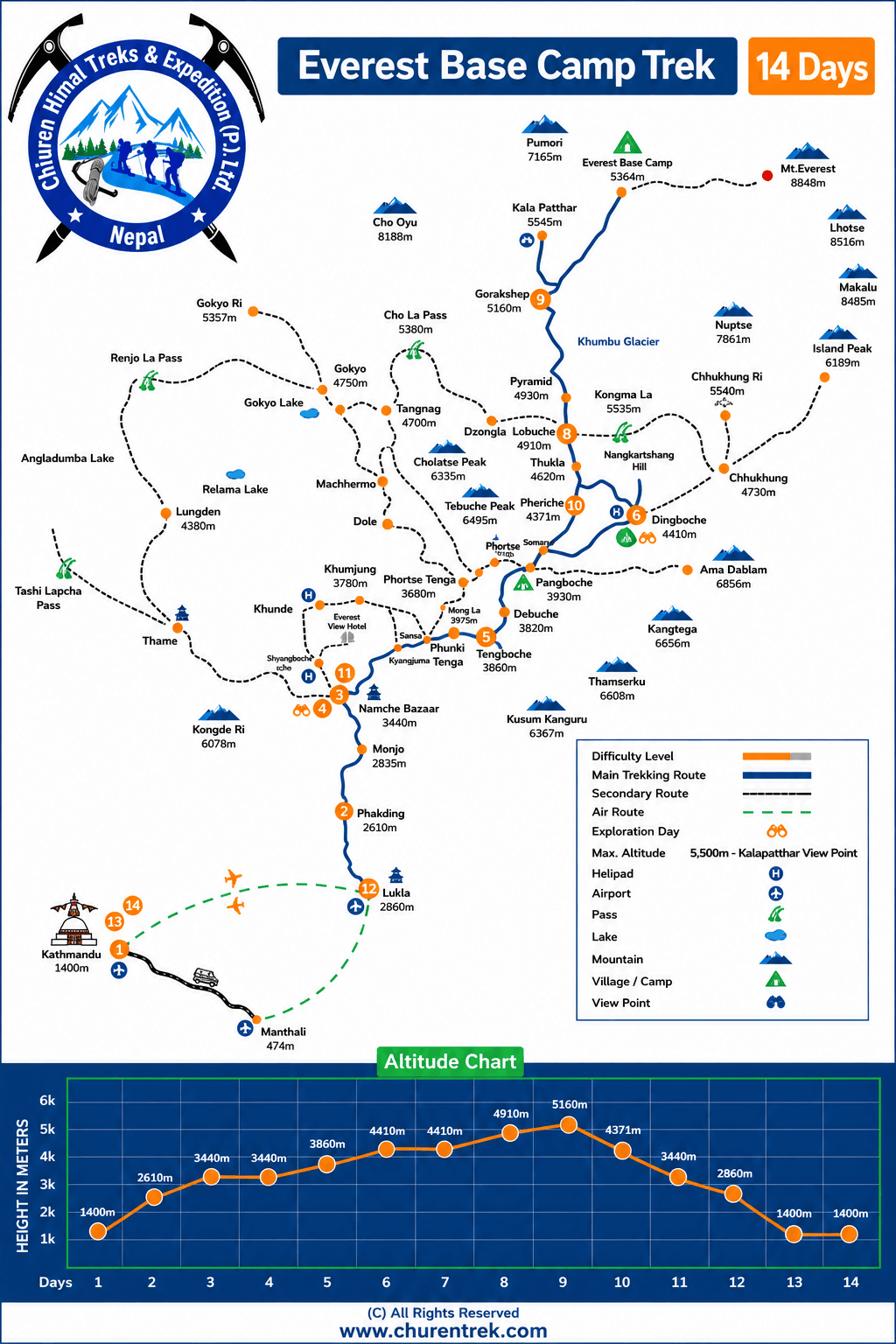
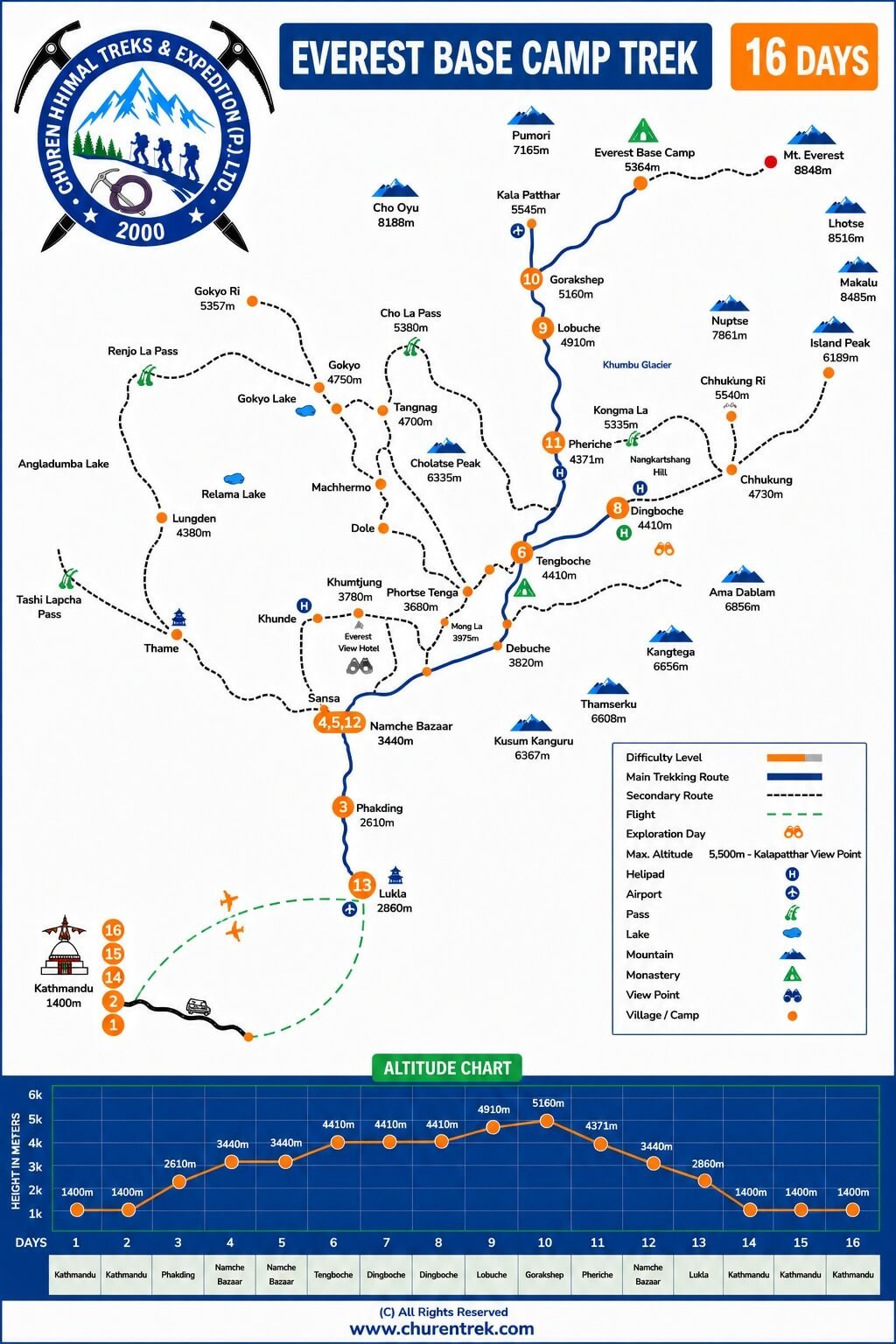
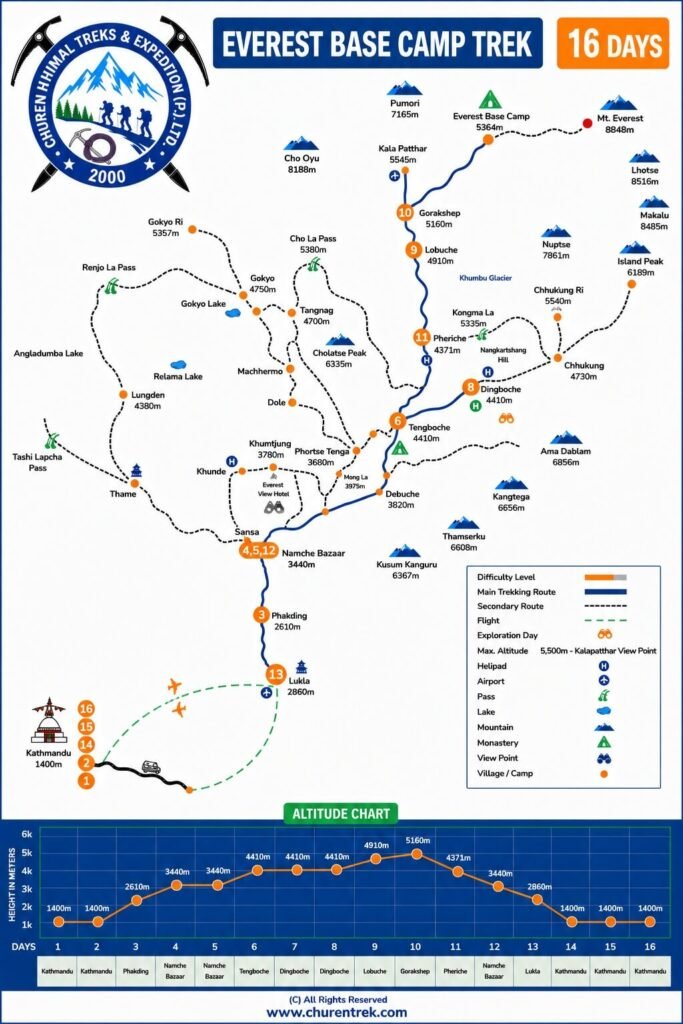
Everest Base Camp Trek Route Map
Everest Base Camp Trek – 16 Days route map
Everest Base Camp Trek Route Map Full Zoom View
Link copied to clipboard!
Price starts US$ 1720
1390 US$

We offer group discount

1 personUS$ 1590
2 peopleUS$ 1390
3 - 6 peopleUS$ 1350
7 - 10 peopleUS$ 1290
11 + peopleUS$ 1190
  • Best price guarantee
  • Secure & easy online booking
  • Flexible booking dates

Speak to an Expert

Sujan
Nepal 🇳🇵
WhatsApp +9779851233710

Annapurna Circuit Trek – 14 Days Highlights

  • Cross Thorong La Pass at approximately 5,416 meters: Experience one of the world's highest trekking passes with stunning views of surrounding Himalayan peaks.
  • Explore the high-altitude Manang Valley: Discover unique landscapes, cultural heritage, and vital acclimatization locations.
  • Experience spectacular views of the Annapurna range: Enjoy panoramic vistas of Annapurna, Dhaulagiri, and other major peaks throughout the journey.
  • Walk through contrasting landscapes: Journey from lush green forests to the dry, dramatic Himalayan terrain of Mustang.
  • Visit the sacred pilgrimage site of Muktinath: Explore the revered temple complex sacred to both Hindus and Buddhists.
  • Explore the atmospheric village of Kagbeni: Walk through medieval alleyways at the gateway to Upper Mustang.
  • Travel through the dramatic Kali Gandaki Valley: Pass through one of the deepest river gorges in the world.
  • Experience Tibetan-influenced architecture: Discover traditional stone houses, prayer wheels, chortens, and vibrant Buddhist traditions.
  • Visit Braga Monastery near Manang: Explore one of the oldest and most culturally significant monasteries in the region.
  • See the distinctive Paungda Danda rock face: Marvel at this massive curved rock wall towering over the Marsyangdi River.
  • Experience traditional mountain villages: Meet local communities and experience authentic Himalayan hospitality along the route.
  • Enjoy changing vegetation and climate: Observe dramatic ecological shifts as altitude increases from subtropical forests to alpine deserts.
  • Travel through the Jomsom region: Explore the windy, scenic landscapes of Lower Mustang.
  • Combine trekking with scenic road journeys: Enjoy diverse travel experiences across varied mountain terrain and valleys.
  • Finish the adventure in Pokhara: Conclude your trek in the beautiful lakeside city before returning to Kathmandu.

Annapurna Circuit Trek – 14 Days

The Annapurna Circuit Trek – 14 Days is a classic Himalayan journey through the diverse landscapes of central Nepal, connecting the subtropical foothills with the high-altitude valleys of Manang and the Mustang region. The route combines mountain scenery, traditional villages, Buddhist monasteries, dramatic river valleys and the challenging crossing of Thorong La Pass at approximately 5,416 meters (17,769 feet).

This 14-day itinerary begins with cultural sightseeing in Kathmandu before traveling toward Dharapani, then follows the trekking route through Chame, Pisang and Manang. After an acclimatization day in Manang, the trail climbs toward Yak Kharka and Thorong Phedi before crossing Thorong La to reach the sacred pilgrimage destination of Muktinath.

The journey continues through the Kali Gandaki Valley, Kagbeni and Jomsom before traveling to Pokhara and Kathmandu. The itinerary supplied for this program follows this general sequence.

For travelers looking for a relatively compact way to experience the classic Annapurna Circuit, this itinerary combines trekking with road transportation and includes time for acclimatization before the highest section of the route.

Annapurna Circuit Trek – 14 Days Itinerary

  • Day 01: Arrival in Kathmandu-1,350m
    +

    Arrive at Tribhuvan International Airport in Kathmandu, where a Churen Himal Treks representative can welcome you and arrange the transfer to your hotel. Transportation may be by private car, van or bus depending on group size. After settling in, enjoy a welcome dinner featuring Nepali cuisine and cultural entertainment. This provides an introduction to Nepalese hospitality before beginning the Annapurna adventure.

    Duration: Arrival/transfer day
    Elevation: Kathmandu – approximately 1,350 m
    Walking Distance: No trekking
    Height Difference (+/-): Minimal | Meal: Welcome dinner, according to package arrangement | Accommodation: 3-star hotel
  • Day 02: Kathmandu Heritage Sightseeing
    +

    Spend the day exploring Kathmandu Valley's cultural heritage. The itinerary includes **Pashupatinath Temple, Boudhanath Stupa, Kathmandu Durbar Square and Swayambhunath**, commonly known as the Monkey Temple. The day introduces travelers to Nepal's religious traditions, historic architecture and living cultural heritage before heading into the Himalayan foothills.

    Duration: Full day
    Elevation: Kathmandu – approximately 1,350 m
    Walking Distance: Sightseeing walks
  • Day 03: Kathmandu to Dharapani – Scenic Mountain Drive
    +

    Leave Kathmandu and travel toward Dharapani, the starting point of the trekking section in this itinerary. The journey passes through Nepal's hilly landscape, with rivers, terraced farmland, villages and changing mountain scenery. The road journey can be long, and actual travel time depends on traffic, road conditions, weather and construction. Dharapani provides the transition from the road journey into the Annapurna trekking environment.

    Duration: Approximately 10 hours, subject to road conditions
    Elevation: Dharapani – approximately 1,860 m
    Walking Distance: No scheduled trekking
    Height Difference (+/-): Primarily road ascent | Meal: Breakfast, lunch and dinner | Accommodation: Tea house/guest house
  • Day 04: Dharapani to Chame – Into the Annapurna Mountains
    +

    The trek begins through forested mountain terrain as the trail follows the Marsyangdi Valley toward Chame, administrative center of Manang District. Along the route, views begin opening toward the surrounding Himalayan peaks, including **Lamjung Himal and Annapurna II**. Depending on the route and conditions, trekkers can also experience the natural hot springs near Chame. The landscape becomes increasingly dramatic as the valley narrows and the trail moves deeper into the Annapurna region.

    Duration: Approximately 5–6 hours
    Elevation: Chame – approximately 2,710 m
    Walking Distance: Approximately 15 km, route dependent
    Height Difference (+/-): Approx. +850 m net elevation | Meal: Breakfast, lunch and dinner | Accommodation: Tea house/guest house
  • Day 05: Chame to Pisang – Through the Narrow Marsyangdi Valley
    +

    Today's trail follows the Marsyangdi Valley toward Pisang. The surroundings become more alpine as the altitude increases and the valley takes on a distinctly Himalayan character. One of the memorable geological features is the dramatic **Paungda Danda rock face**, while views toward Annapurna II and Pisang Peak add to the scenery. The route also marks the transition toward the drier landscapes associated with the Manang Valley.

    Duration: Approximately 5–6 hours
    Elevation: Pisang – approximately 3,200 m
    Walking Distance: Approximately 13–14 km, route dependent
    Height Difference (+/-): Approx. +490 m net elevation | Meal: Breakfast, lunch and dinner | Accommodation: Tea house/guest house
  • Day 06: Pisang to Manang – Entering the Manang Valley
    +

    The trail continues toward Manang, with the **Upper Pisang route** offering an attractive option where trail and weather conditions allow. This route provides broader mountain views and passes through traditional settlements. The landscape becomes noticeably drier and the vegetation thinner as elevation increases. A cultural highlight is **Braga Monastery**, one of the important Buddhist sites in the region. Manang is also the key acclimatization location before the trek continues toward the high-altitude section.

    Duration: Approximately 6–7 hours
    Elevation: Manang – approximately 3,540 m
    Walking Distance: Approximately 15–16 km, route dependent
    Height Difference (+/-): Approx. +340 m net elevation
  • Day 07: Manang Acclimatization Day
    +

    Spend an acclimatization day in Manang to allow the body time to adjust to increasing elevation. Rather than remaining completely inactive, a gradual daytime hike can be arranged around nearby attractions. Possible activities include hiking toward **Gangapurna Lake, Bhojo Gumba or another suitable viewpoint**, depending on current conditions and the group's ability. The objective is to gain some additional altitude during the day while returning to Manang to sleep. Acclimatization is an important part of preparing for the higher elevations ahead.

    Duration: Full day
    Elevation: Manang – approximately 3,540 m
    Walking Distance: Short acclimatization hike, route dependent
    Height Difference (+/-): Variable | Meal: Breakfast, lunch and dinner | Accommodation: Tea house/guest house
  • Day 08: Manang to Yak Kharka / Letdar
    +

    The trail leaves Manang and gradually climbs toward the high alpine zone. Vegetation becomes increasingly sparse, while the surrounding terrain opens into broad mountain slopes and grazing areas. Yak Kharka and Letdar are commonly used as stopping points before Thorong Phedi. The supplied itinerary specifically asks for the altitude to be checked because accommodation locations can differ. The exact overnight elevation should therefore be confirmed with the local lodge and guide when the trip is operated.

    Duration: Approximately 4–5 hours
    Elevation: Yak Kharka/Letdar area – approximately 4,000–4,200 m depending on overnight location
    Walking Distance: Approximately 9–11 km, route dependent
    Height Difference (+/-): Significant ascent
  • Day 09: Yak Kharka / Letdar to Thorong Phedi
    +

    Today's relatively short trekking stage is designed to position the group for the major Thorong La crossing. The trail continues through increasingly barren high-altitude terrain with dramatic mountain surroundings. Depending on the selected overnight location, the route may involve crossing suspension bridges and navigating steep sections. After reaching Thorong Phedi, trekkers should focus on rest, hydration and preparation for the early start required for the pass crossing.

    Duration: Approximately 3–4 hours
    Elevation: Thorong Phedi – approximately 4,450 m
    Walking Distance: Approximately 7 km, route dependent
    Height Difference (+/-): Gradual ascent
  • Day 10: Thorong Phedi to Muktinath via Thorong La Pass
    +

    This is the defining day of the Annapurna Circuit. The trek begins early, climbing steadily from Thorong Phedi toward **Thorong La Pass at approximately 5,416 meters**. The ascent can be physically demanding because of altitude, cold temperatures and the length of the day. At the pass, trekkers reach the highest point of the itinerary before beginning the long descent toward Muktinath. Muktinath is an important pilgrimage destination for both Hindus and Buddhists. Reaching the village after crossing the pass marks a major milestone in the circuit.

    Duration: Approximately 7–10 hours, depending on conditions and pace
    Elevation: Thorong La – approximately 5,416 m; Muktinath – approximately 3,800 m
    Walking Distance: Approximately 14–16 km, route dependent
    Height Difference (+/-): Major ascent followed by substantial descent | Meal: Breakfast, lunch and dinner | Accommodation: Tea house/guest house
  • Day 11: Muktinath to Kagbeni and Jomsom
    +

    Leave Muktinath and travel through the distinctive landscapes of Lower Mustang toward Kagbeni and Jomsom. **Kagbeni**, situated near the confluence area of the Kali Gandaki system, is known for its historic village character and Tibetan-influenced cultural heritage. Road construction and changing trail conditions mean this section may involve a **combination of walking and road transportation**, rather than an uninterrupted foot trail. The exact arrangement should be confirmed according to current local conditions. The supplied brief specifically identifies this as a section requiring route-condition verification.

    Duration: Approximately 5–6 hours of walking, route dependent
    Elevation: Jomsom – approximately 2,720 m
    Walking Distance: Approximately 18 km if substantially walked, route dependent
    Height Difference (+/-): Major descent
  • Day 12: Jomsom to Pokhara – Through the Kali Gandaki Corridor
    +

    Leave Jomsom and travel toward Pokhara through the Kali Gandaki corridor. The landscape gradually changes from the dry, high-altitude environment of Mustang toward greener valleys and lower Himalayan hills. The journey can include waterfalls, villages, river valleys and dramatic changes in vegetation. Road conditions can vary considerably, so the stated travel time should be regarded as approximate rather than guaranteed. Arrive in Pokhara and enjoy the comforts of a lower-altitude city after the high mountain section.

    Duration: Approximately 7–8 hours by road, subject to conditions
    Elevation: Pokhara – approximately 800 m
    Walking Distance: No scheduled trekking
    Height Difference (+/-): Major descent | Meal: Breakfast and other meals according to package | Accommodation: 3-star hotel
  • Day 13: Pokhara to Kathmandu
    +

    Travel from Pokhara back to Kathmandu, following Nepal's hill roads and river corridors. The journey provides another perspective on the country's changing geography, passing through villages, terraced hillsides, rivers and mountain foothills. The actual journey time can vary because of traffic, weather, road maintenance and other conditions.

    Duration: Approximately 7–8 hours by road, subject to conditions
    Elevation: Kathmandu – approximately 1,350 m
    Walking Distance: No scheduled trekking
    Height Difference (+/-): Road ascent | Meal: Breakfast | Accommodation: 3-star hotel
  • Day 14: Final Departure from Kathmandu
    +

    Your Annapurna Circuit adventure concludes with a transfer to Tribhuvan International Airport according to your international flight schedule. Travelers with additional time can extend their Nepal holiday with cultural tours, wildlife experiences, rafting, scenic flights, cycling or another Himalayan trekking adventure.

    Duration: Airport transfer according to flight schedule
    Elevation: Kathmandu – approximately 1,350 m
    Walking Distance: None
    Meal: Breakfast, according to package arrangement | Accommodation: None

Cost Includes

  • AIRPORT PICK-UP & DROP : Airport - Hotel transfers – Airport (Pick Up and Drop) by private Car/Van/Bus as per group size.
  • ACCOMMODATION IN KATHMANDU : 3 nights hotel (3-star category) in Kathmandu – Sharing twin Bedroom on BB Plan.
  • ACCOMMODATION IN POKHARA : 1 nights hotel (3-star category) in Pokhara – Sharing twin Bedroom on BB Plan.
  • WELCOME DINNER : 1 complementary Welcome dinner in a typical Nepali restaurant with a cultural program in Kathmandu.
  • PERMITS : All necessary paper works: Annapurna Conservation area permit, TIMS Card & conservation entry fee.
  • INSURANCE : Insurance for all involved Nepalese staff during the trek (Guide,Assitance guide,porter & driver).
  • MAP : Annapurna Region Trekking map.
  • MEMBER TRANSPORTATION : Land Transportation: Drive from Kathmandu – Besishahar and Jomsom - Pokhara by local bus, while returning Pokhara to Kathmandu (by tourist vehicles). Drive-by local jeep : Besishahar – Dharapani.
  • MEMBER LUGGAGE : Up to 13 Kg per member for personal baggage during the trek carrying by porters.
  • FOODS & LODGING : Food 3 meals a day (BLD; including tea and coffee) along with accessible accommodation at tea houses/lodges during the trek.
  • GUIDE : Local government-licensed Guide (English speaking) during the trek and sight-seeing in Kathmandu valley.
  • PORTER : A Strong helpful porter with proper equipment (2 trekkers: 1 porter) during the trek.
  • STAFF SALARY & ALLOWANCE : All Nepalese staff & porter’s daily wages, salary, equipment, food & clothing.
  • VALLEY SIGHTSEEING : Sightseeing in Kathmandu Valley [ Swoyambu (Monkey temple),Boudhanath stupa ,Pasupatinath Temple and Kathmandu Durbar Square] by a professional guide.
  • MEDICAL KIT : Comprehensive Medical kit.
  • COMPLIMENTARY SERVICES FROM CHUREN HIMAL : Oximeter to check your pulse, oxygen saturation, and heart rate,Daily seasonal fruits for dessert,Churen Himal Duffle Bag for the Trek ,Churen Himal Trekking T-Shirt or Cap, oxygen bottle on hand in an emergency (in group) Satellite phone for emergency.
  • CERTIFICATE : Adventure certificate & Token of Love after successful trekking

Cost Excludes

  • INTERNATIONAL AIRFARE : International flight airfare (from and to Kathmandu).
  • NEPAL VISA FEES : 15 Days – 30 USD,30 Days – 50 USD & 90 Days – 125 USD
  • LUNCH & DINNER : Lunch & dinner during the stay in Kathmandu & Pokhara (also in case of early return from Trekking than the scheduled itinerary).
  • EXTRA NIGHTS IN KATHMANDU & POKHARA : Extra nights’ accommodation in Kathmandu & Pokhara. In case of early arrival or late departure, early return from Trekking (due to any reason) than the scheduled itinerary.
  • INSURANCE : Travel and high altitude insurance, accident, medical & emergency evacuation.
  • RESCUE EVACUATION : Medical Insurance and emergency rescue evacuation cost if required. (Rescue, Repatriation, Medication, Medical Tests, and Hospitalization costs.)
  • PERSONAL EXPENSES : Telephone calls, Internet, Toiletries, battery recharge, hot shower, laundry, soft drinks, beer, and any alcoholic beverages.
  • PERSONAL EQUIPMENT : Clothing, Packing Items or Bags, Personal Medical Kit, Personal Trekking Gears, etc.
  • TOILETRIES : Soaps, shampoos, toilet and tissue papers, toothpaste, and other items used to keep yourself clean.
  • FILMING : Special Filming, Camera, and Drone permit fee.
  • INTERNET SERVICE : Internet facility during the trek is not included.
  • EXTRA PORTER : $20 USD for an extra porter per day (If an extra porter is demanded).
  • TIPS : Tipping is a culture in Nepal and is expected by your staff (guides, porters, drivers)
  • EXTRA : Any other services or activities, which are not mentioned in the itinerary. Any other item not listed in the “Cost Includes” section.

Departure Dates

Starting Date End Date Availability Price

Trip Information

Who Is the Annapurna Circuit Trek For?

The Annapurna Circuit is suitable for travelers who enjoy multi-day mountain trekking and are prepared for long walking days, changing weather and substantial altitude gain.

Previous Himalayan trekking experience can be helpful but is not necessarily essential for a properly prepared traveler. More important are reasonable cardiovascular fitness, walking endurance and the ability to handle consecutive days on mountainous terrain.

The greatest physical challenge is the combination of altitude and the Thorong La Pass crossing. The itinerary includes an acclimatization day in Manang, which is particularly important before continuing toward the higher sections of the route.

Travelers with medical conditions or concerns about high-altitude trekking should seek advice from an appropriately qualified medical professional before departure.

Annapurna Circuit Trek Difficulty

The Annapurna Circuit Trek is generally considered a moderate-to-challenging Himalayan trek, with the difficulty increasing significantly around the Thorong La section.

The lower sections of the route include forests, villages and relatively varied terrain. As the trail approaches Manang and moves toward Yak Kharka and Thorong Phedi, vegetation becomes increasingly sparse and the environment more alpine.

The most demanding day is normally the crossing from Thorong Phedi to Muktinath via Thorong La. The day begins early because trekkers need to climb to the pass and then descend to Muktinath.

Altitude is an important consideration. A gradual ascent, appropriate acclimatization, hydration, rest and awareness of altitude-related symptoms are important parts of responsible trekking preparation.

Best Time for Annapurna Circuit Trek

  • Spring: March to May: Spring is one of the popular trekking seasons in Nepal. The lower elevations become greener and temperatures are generally favorable for trekking. Mountain visibility can be good, although conditions can change quickly.
  • Autumn: September to November: Autumn generally offers favorable trekking conditions, relatively stable weather and good mountain visibility. It is also one of the busiest periods on popular Himalayan routes.
  • Winter: December to February: Winter brings colder temperatures and increased snow and ice potential at higher elevations. Thorong La Pass conditions can be particularly important during this period, and route accessibility may depend on current weather and trail conditions.
  • Monsoon: June to August: The monsoon brings substantial rainfall to many parts of Nepal. The Annapurna Circuit's rain-shadow sections around Manang and Mustang can be comparatively drier, but road travel, lower-elevation trails, landslides and weather-related delays can still affect the journey.

No season guarantees particular weather conditions. Conditions around Thorong La should always be checked shortly before departure.

Annapurna Circuit Trek Permits

The Annapurna Circuit passes through the Annapurna Conservation Area, so the applicable conservation-area permit requirements need to be arranged before entering the trekking region.

Annapurna Conservation Area Permit (ACAP): The Annapurna Conservation Area Permit is generally associated with trekking within the Annapurna Conservation Area.

TIMS / Trekking Registration: Trekking registration requirements in Nepal can change, particularly regarding independent trekkers, organized groups and guide requirements. Therefore, the applicable TIMS or current trekking-registration requirements should be confirmed immediately before booking and departure.

Permit fees and procedures should also be checked against the current Nepal Tourism Board/authorized issuing authority requirements rather than relying on outdated online information.

Annapurna Circuit Trek Cost

The cost of a 14-day Annapurna Circuit package depends on the services included and the operating conditions of the trip.

Important factors include:

  • Kathmandu hotel category
  • Pokhara hotel category
  • Tea-house accommodation
  • Meals
  • Licensed guide
  • Porter service
  • Conservation-area and trekking permits
  • Ground transportation
  • Group size
  • Season
  • Airport transfers
  • Additional sightseeing
  • Travel insurance
  • Personal expenses
  • Optional transportation
  • Additional accommodation or services

Because no confirmed package price was supplied in the source material, a specific price should not be published without confirmation from Churen Himal Treks.

For the current price and customized arrangements, travelers can contact:
Churen Himal Treks and Expedition Pvt. Ltd.
Website: https://www.churentrek.com
Email: info@churentrek.com

Accommodation During the Annapurna Circuit

Kathmandu: The itinerary specifies 3-star hotel accommodation in Kathmandu.

Trekking Route: Accommodation during the trekking section is generally in tea houses or guest houses. Facilities vary from village to village. Rooms commonly have basic beds and bedding, while bathrooms may be private or shared depending on the lodge. Hot showers, electricity, Wi-Fi and charging facilities may be available for an additional fee and should not be assumed at every overnight stop.

Pokhara: The supplied itinerary specifies 3-star hotel accommodation in Pokhara.

Food and Drinks

Food on the Annapurna Circuit reflects both local Nepalese cuisine and dishes designed for international trekkers.

Common options include:

  • Dal bhat
  • Rice
  • Noodles
  • Pasta
  • Soups
  • Tibetan bread
  • Momos
  • Potatoes
  • Eggs
  • Vegetables
  • Porridge
  • Pancakes
  • Tea
  • Coffee

Dal bhat—rice served with lentil soup and accompanying vegetables—is particularly common and provides a substantial meal during trekking.

At higher elevations, trekkers should prioritize adequate hydration and meals that are comfortable for them to digest. Dietary requirements such as vegetarian or vegan meals should be communicated when booking.

Annapurna Circuit Trek Packing List

Clothing:

  • Moisture-wicking base layers
  • Fleece jacket
  • Down jacket
  • Waterproof jacket
  • Trekking trousers
  • Warm gloves
  • Warm hat
  • Sun hat
  • Extra socks

Footwear:

  • Broken-in trekking boots
  • Lightweight camp shoes
  • Trekking poles

Protection:

  • Sunglasses
  • Sunscreen
  • Lip balm with sun protection
  • Sun hat
  • Water bottles
  • Water purification tablets/filter

Equipment:

  • Backpack or duffel bag
  • Sleeping bag
  • Headlamp
  • Power bank
  • Charging cables
  • Small daypack
  • Trekking poles

Personal Items:

  • Personal hygiene products
  • Personal first-aid supplies
  • Prescription medication
  • Travel documents
  • Passport copies
  • Insurance information
  • Cash

Equipment requirements vary according to the season, especially for winter departures.

Fitness and Preparation

Preparation for the Annapurna Circuit should focus on endurance rather than simply speed.

Useful preparation includes:

  • Regular walking
  • Hiking on uneven terrain
  • Stair climbing
  • Cardiovascular training
  • Leg and core strengthening
  • Long weekend hikes
  • Uphill and downhill practice
  • Carrying a light backpack
  • Consecutive-day walking

A useful goal is to gradually increase the duration and elevation of training hikes before departure.

Because the trek reaches more than 5,000 meters, physical preparation alone cannot eliminate altitude-related risks.

Safety and Altitude

Altitude is one of the most important considerations on the Annapurna Circuit. The itinerary includes an acclimatization day in Manang before progressing to the higher elevations.

Trekkers should:

  • Ascend gradually.
  • Allow time for acclimatization.
  • Stay adequately hydrated.
  • Avoid unnecessary overexertion.
  • Inform the guide if they feel unwell.
  • Take altitude-related symptoms seriously.
  • Follow professional guidance regarding ascent and descent.

Symptoms associated with altitude illness can include headache, nausea, dizziness, unusual tiredness and difficulty sleeping. More serious symptoms require urgent attention.

If significant altitude-related symptoms develop, continuing to ascend can be dangerous. Descent and professional medical assessment may be required.

Travelers should consult a qualified healthcare professional about individual altitude risks before undertaking the trek.

Transportation

Transportation is an important part of this 14-day itinerary.

Kathmandu to Dharapani: The supplied itinerary allocates approximately 10 hours for the journey to Dharapani. Actual travel time can vary substantially because of traffic, road conditions, weather and construction.

Jomsom to Pokhara: The itinerary includes an approximately 7–8-hour road journey from Jomsom to Pokhara.

Pokhara to Kathmandu: The itinerary estimates approximately 7–8 hours for the journey from Pokhara to Kathmandu. The supplied material refers to a journey of approximately 200 km.

Road travel in Nepal is affected by weather, traffic, roadworks and seasonal conditions. Travel times should therefore be considered estimates.

Travel Insurance

Travel insurance should be appropriate for the actual altitude and activities included in the itinerary.

Before departure, check whether the policy covers:

  • High-altitude trekking
  • Emergency medical treatment
  • Emergency evacuation
  • Trip interruption
  • Trip cancellation where applicable
  • Baggage loss or delay

Travelers should read the policy conditions carefully, including altitude limits and exclusions.

Responsible and Sustainable Trekking

Responsible travel helps protect the environment and supports Himalayan communities.

During the trek:

  • Carry reusable water bottles.
  • Minimize single-use plastic.
  • Dispose of waste properly.
  • Stay on established trails.
  • Respect local customs.
  • Dress appropriately around religious sites.
  • Ask before photographing people.
  • Respect monasteries and temples.
  • Support local tea houses and businesses.
  • Avoid disturbing wildlife.
  • Follow local conservation rules.

Why Trek with Churen Himal Treks and Expedition?

Churen Himal Treks and Expedition Pvt. Ltd. provides trekking and travel services for visitors exploring Nepal and the Himalayan region.

For the Annapurna Circuit, travelers can discuss itinerary arrangements, transportation, accommodation, guiding services and customized trip requirements with the company.

Rather than presenting unsupported claims about rankings or awards, the company information should focus on transparent services and practical assistance throughout the trip.

Plan Your Annapurna Circuit Adventure

For the latest package cost, availability, permit requirements and customized itinerary, contact:
Churen Himal Treks and Expedition Pvt. Ltd.
🌐 https://www.churentrek.com
✉️ info@churentrek.com

Book your Annapurna Circuit Trek – 14 Days and prepare to experience Manang, Thorong La, Muktinath, Kagbeni and the spectacular landscapes of the Annapurna region.

Price starts US$ 1720
1390 US$

We offer group discount

1 personUS$ 1590
2 peopleUS$ 1390
3 - 6 peopleUS$ 1350
7 - 10 peopleUS$ 1290
11 + peopleUS$ 1190
  • Best price guarantee
  • Secure & easy online booking
  • Flexible booking dates

Speak to an Expert

Sujan
Nepal 🇳🇵
WhatsApp +9779851233710

FAQs for Everest Base Camp Trek – 16 Days

FAQs for Everest Base Camp Trek – 16 Days

ℹ️ General

+
➔
What is the Everest Base Camp Trek and why is it popular?
It is a world-famous 14-day Himalayan adventure taking you to the base of Mt. Everest through ancient Sherpa villages and stunning landscapes.
➔
How difficult is the Everest Base Camp Trek?
The trek is moderately challenging, requiring good physical stamina for multi-day walking but no technical climbing skills.
➔
How many days does the trek take in total?
The standard Everest Base Camp Trek itinerary offered by Glorious Eco Trek Nepal takes 14 days in total.
➔
Is prior trekking experience necessary for this trip?
No prior trekking experience is mandatory as long as you are healthy, motivated, and in good physical condition.
➔
Can solo travelers join a group trek?
Yes, solo travelers can join our organized group departures or trek with a dedicated personal guide.

🏋️ Preparation & Fitness

+
➔
Is the Everest Base Camp Trek physically challenging?
Yes, walking 5 to 7 hours daily over steep mountain terrain at high altitudes tests your endurance.
➔
Do I need to train before doing the Everest Base Camp Trek?
Yes, pre-trip physical conditioning makes the journey significantly more comfortable and enjoyable.
➔
How many weeks should I train before the EBC trek?
We recommend beginning cardiovascular and endurance training at least 8 to 12 weeks before your trip.
➔
What is the best way to prepare for the Everest Base Camp Trek?
Focus on aerobic workouts like running and swimming alongside stair-climbing with a weighted daypack.
➔
How can I acclimatize to high altitude faster?
Walk at a steady, slow pace, drink 3-4 liters of water daily, avoid alcohol, and strictly follow our rest day schedules.
➔
How many hours will I walk each day during the EBC trek?
You will walk an average of 5 to 7 hours each day depending on the distance between teahouses.
➔
Can first-time trekkers do the Everest Base Camp Trek?
Yes, motivated first-time trekkers with a basic fitness foundation successfully complete the trek every year.

🪪 Permits

+
➔
What permits are required for the Everest Base Camp Trek?
You need the Sagarmatha National Park Entry Permit and the Khumbu Pasang Lhamu Rural Municipality Permit.
➔
Will Glorious Eco Trek Nepal arrange all the necessary permits?
Yes, our team handles all paperwork and arranges all required permits for you.

🛂 Insurance & Visa

+
➔
Do I need travel insurance for the Everest Base Camp Trek?
Yes, travel insurance is strictly mandatory for all trekkers on this expedition.
➔
How do I get a tourist visa for Nepal?
You can fill out the online pre-visa form or apply directly upon arrival at Kathmandu Airport.
➔
Can I get a visa on arrival at the airport?
Yes, tourist visas on arrival are available at Tribhuvan International Airport for most nationalities.
➔
What should the insurance cover for trekking in Nepal?
Your policy must specifically cover high-altitude medical treatment and emergency helicopter evacuation up to 6,000 meters.

💂 Guides & Support Staff

+
➔
Will I have a guide and porter during the trek?
Yes, our standard trip package includes a licensed local guide and helpful porters.
➔
What are the qualifications of your trekking guides?
Our guides are government-certified professionals trained in wilderness first aid and emergency response.
➔
Do the guides speak English?
Yes, all of our guides speak fluent English to ensure seamless communication.
➔
Will porters carry my luggage during the trek?
Yes, porters carry your main heavy duffel bag so you only carry a small, light daypack.
➔
Is tipping guides and porters expected?
Tipping is a traditional way in Nepal to express gratitude to support staff for their hard work.
➔
Can I trek to Everest Base Camp without a guide?
No, current government regulations mandate that all foreign trekkers must be accompanied by a licensed guide.

🛏️ Accommodation and Facilities

+
➔
What kind of accommodation is provided during the trek?
You will stay in traditional, cozy mountain teahouses featuring twin-share bedrooms and a central heated dining room.
➔
Are hot showers and Wi-Fi available along the trail?
Yes, hot showers and Wi-Fi access cards are available at most teahouses for a small extra fee.
➔
Will I get a private room or have to share?
Rooms are structured as twin-sharing for two travelers, though private single rooms can be arranged upon request when available.
➔
Can I charge my phone and devices during the trek?
Yes, charging stations are available in teahouse dining rooms for a nominal hourly rate.
➔
Are toilets available throughout the trek?
Shared indoor toilets are provided in teahouses, ranging from standard Western seats to traditional squat toilets.

🍲 Food and Drinks

+
➔
What kind of food is available during the trek?
Teahouse menus offer fresh meals like traditional Nepali Dal Bhat, soups, fried rice, noodles, eggs, and pasta.
➔
Are vegetarian or vegan meals available?
Yes, vegetarian and vegan choices are widely available and recommended for optimal health at altitude.
➔
Is it safe to drink the water during the trek?
Untreated tap water is unsafe; always drink boiled teahouse water or use purification tablets/UV filters.
➔
Can I buy snacks and drinks along the way?
Yes, small village shops along the path sell bottled drinks, snacks, and chocolate bars.

🌤️ Weather & Seasons

+
➔
What is the best time to do the Everest Base Camp Trek?
Spring (March to May) and Autumn (September to November) offer clear skies and ideal temperatures.
➔
Can I trek during the monsoon or winter season?
Trekking is possible in winter or monsoon, but involves colder conditions, snow, or rain and potential flight delays.
➔
What kind of weather can I expect during the trek?
Daytime walking weather is typically pleasant, but night temperatures drop below freezing at high altitudes.

🩺 Health & Safety

+
➔
What happens if I get sick or injured during the trek?
Your guide will provide immediate first aid, arrange descent if needed, or summon a rescue helicopter for emergency transport.
➔
How do you handle altitude sickness?
We monitor oxygen levels daily, carry emergency first-aid supplies, and enforce immediate descent if severe symptoms appear.
➔
Are there health posts or clinics along the route?
Yes, basic medical posts operate at Namche Bazaar and Pheriche to assist ill or injured trekkers.
➔
Is the trek safe for solo female travelers?
Yes, Nepal is very welcoming, and trekking with our vetted licensed guides guarantees safety and security.
➔
Do I need to bring medicines for the Everest Base Camp Trek?
Yes, pack personal items like Diamox (for altitude), pain relievers, rehydration salts, and blister treatments.

🎒 Packing & Gear

+
➔
What should I pack for the Everest Base Camp Trek?
Key items include thermal clothing layers, a heavy down jacket, broken-in trekking boots, gloves, and a sleeping bag.
➔
Is a sleeping bag necessary?
Yes, a sub-zero rated sleeping bag (-10°C to -15°C) is essential as teahouse rooms are unheated at night.
➔
Where can I keep my extra luggage during the trek?
You can store non-trekking travel luggage for free at your hotel in Kathmandu before heading out.
➔
What is the luggage weight limit for the Lukla flight?
The domestic Lukla flight weight limit is 15 kg total (10 kg main bag + 5 kg hand carry).
➔
How much weight can a porter carry?
A single porter carries up to 25 kg total, usually splitting weight between two trekkers (12.5 kg per person).
➔
Where can I buy trekking clothes and gear?
You can easily buy or rent all essential gear at affordable prices in the Thamel district of Kathmandu.

💳 Booking & Payment

+
➔
What is the booking process and payment method for the Everest Base Camp Trek?
You can reserve online with an advance deposit via card or wire transfer, paying the remaining balance in Kathmandu.
➔
Is there a cancellation or refund policy?
Yes, we provide flexible cancellation policies clearly outlined in our booking agreement terms.
➔
What currency should I carry for expenses along the Everest Base Camp trek?
Carry local Nepali Rupees (NPR) cash for trail purchases as foreign currencies are rarely accepted.
➔
Can I use ATMs or credit cards during the trek?
ATMs on the trail are unreliable and cards are rarely accepted, so carrying cash from Kathmandu is mandatory.
➔
Are there money exchange services in the Everest Base Camp region?
Money exchange services are available in Namche Bazaar but offer lower rates than Kathmandu banks.
➔
How much extra money should I budget per day during the trek?
Budget roughly $15 to $25 per day for extra personal expenses like hot drinks, snacks, showers, and battery charging.
➔
Can I book the Everest Base Camp trek if I’m traveling with children?
Yes, healthy children can join provided you arrange a customized, slower-paced itinerary for safety.
➔
Should I book the trek well in advance?
Yes, booking 3 to 6 months in advance ensures guaranteed Lukla flight tickets and premium teahouse rooms.

🛫 Transportation & Flight

+
➔
Do you provide airport pick-up and drop-off services?
Yes, private airport pickup and drop-off transfers are included in our package.
➔
How do I get to the starting point of the trek?
You reach the trail's starting point via a scenic mountain flight to Lukla Airport.
➔
Is the flight to Lukla safe?
Yes, Lukla flights are operated by highly experienced mountain pilots who fly only in clear, safe weather.
➔
What happens if my Lukla flight is delayed or canceled?
Flight schedules shift to the next clear day or alternative helicopter rides can be organized if requested.
➔
What is the mode of transportation to reach Everest Base Camp?
After landing in Lukla, the remaining journey to Base Camp and back is completed entirely on foot.
Churen Trek - Mobile FAQs

ℹ️ General

+
What is the Everest Base Camp Trek and why is it popular?
It is a world-famous 14-day Himalayan adventure taking you to the base of Mt. Everest through ancient Sherpa villages and stunning landscapes.
+
How difficult is the Everest Base Camp Trek?
The trek is moderately challenging, requiring good physical stamina for multi-day walking but no technical climbing skills.
+
How many days does the trek take in total?
The standard Everest Base Camp Trek itinerary offered by Glorious Eco Trek Nepal takes 14 days in total.
+
Is prior trekking experience necessary for this trip?
No prior trekking experience is mandatory as long as you are healthy, motivated, and in good physical condition.
+
Can solo travelers join a group trek?
Yes, solo travelers can join our organized group departures or trek with a dedicated personal guide.

🏋️ Preparation & Fitness

+
Is the Everest Base Camp Trek physically challenging?
Yes, walking 5 to 7 hours daily over steep mountain terrain at high altitudes tests your endurance.
+
Do I need to train before doing the Everest Base Camp Trek?
Yes, pre-trip physical conditioning makes the journey significantly more comfortable and enjoyable.
+
How many weeks should I train before the EBC trek?
We recommend beginning cardiovascular and endurance training at least 8 to 12 weeks before your trip.
+
What is the best way to prepare for the Everest Base Camp Trek?
Focus on aerobic workouts like running and swimming alongside stair-climbing with a weighted daypack.
+
How can I acclimatize to high altitude faster?
Walk at a steady, slow pace, drink 3-4 liters of water daily, avoid alcohol, and strictly follow our rest day schedules.
+
How many hours will I walk each day during the EBC trek?
You will walk an average of 5 to 7 hours each day depending on the distance between teahouses.
+
Can first-time trekkers do the Everest Base Camp Trek?
Yes, motivated first-time trekkers with a basic fitness foundation successfully complete the trek every year.

🪪 Permits

+
What permits are required for the Everest Base Camp Trek?
You need the Sagarmatha National Park Entry Permit and the Khumbu Pasang Lhamu Rural Municipality Permit.
+
Will Glorious Eco Trek Nepal arrange all the necessary permits?
Yes, our team handles all paperwork and arranges all required permits for you.

🛂 Insurance & Visa

+
Do I need travel insurance for the Everest Base Camp Trek?
Yes, travel insurance is strictly mandatory for all trekkers on this expedition.
+
How do I get a tourist visa for Nepal?
You can fill out the online pre-visa form or apply directly upon arrival at Kathmandu Airport.
+
Can I get a visa on arrival at the airport?
Yes, tourist visas on arrival are available at Tribhuvan International Airport for most nationalities.
+
What should the insurance cover for trekking in Nepal?
Your policy must specifically cover high-altitude medical treatment and emergency helicopter evacuation up to 6,000 meters.

💂 Guides & Support Staff

+
Will I have a guide and porter during the trek?
Yes, our standard trip package includes a licensed local guide and helpful porters.
+
What are the qualifications of your trekking guides?
Our guides are government-certified professionals trained in wilderness first aid and emergency response.
+
Do the guides speak English?
Yes, all of our guides speak fluent English to ensure seamless communication.
+
Will porters carry my luggage during the trek?
Yes, porters carry your main heavy duffel bag so you only carry a small, light daypack.
+
Is tipping guides and porters expected?
Tipping is a traditional way in Nepal to express gratitude to support staff for their hard work.
+
Can I trek to Everest Base Camp without a guide?
No, current government regulations mandate that all foreign trekkers must be accompanied by a licensed guide.

🛏️ Accommodation and Facilities

+
What kind of accommodation is provided during the trek?
You will stay in traditional, cozy mountain teahouses featuring twin-share bedrooms and a central heated dining room.
+
Are hot showers and Wi-Fi available along the trail?
Yes, hot showers and Wi-Fi access cards are available at most teahouses for a small extra fee.
+
Will I get a private room or have to share?
Rooms are structured as twin-sharing for two travelers, though private single rooms can be arranged upon request when available.
+
Can I charge my phone and devices during the trek?
Yes, charging stations are available in teahouse dining rooms for a nominal hourly rate.
+
Are toilets available throughout the trek?
Shared indoor toilets are provided in teahouses, ranging from standard Western seats to traditional squat toilets.

🍲 Food and Drinks

+
What kind of food is available during the trek?
Teahouse menus offer fresh meals like traditional Nepali Dal Bhat, soups, fried rice, noodles, eggs, and pasta.
+
Are vegetarian or vegan meals available?
Yes, vegetarian and vegan choices are widely available and recommended for optimal health at altitude.
+
Is it safe to drink the water during the trek?
Untreated tap water is unsafe; always drink boiled teahouse water or use purification tablets/UV filters.
+
Can I buy snacks and drinks along the way?
Yes, small village shops along the path sell bottled drinks, snacks, and chocolate bars.

🌤️ Weather & Seasons

+
What is the best time to do the Everest Base Camp Trek?
Spring (March to May) and Autumn (September to November) offer clear skies and ideal temperatures.
+
Can I trek during the monsoon or winter season?
Trekking is possible in winter or monsoon, but involves colder conditions, snow, or rain and potential flight delays.
+
What kind of weather can I expect during the trek?
Daytime walking weather is typically pleasant, but night temperatures drop below freezing at high altitudes.

🩺 Health & Safety

+
What happens if I get sick or injured during the trek?
Your guide will provide immediate first aid, arrange descent if needed, or summon a rescue helicopter for emergency transport.
+
How do you handle altitude sickness?
We monitor oxygen levels daily, carry emergency first-aid supplies, and enforce immediate descent if severe symptoms appear.
+
Are there health posts or clinics along the route?
Yes, basic medical posts operate at Namche Bazaar and Pheriche to assist ill or injured trekkers.
+
Is the trek safe for solo female travelers?
Yes, Nepal is very welcoming, and trekking with our vetted licensed guides guarantees safety and security.
+
Do I need to bring medicines for the Everest Base Camp Trek?
Yes, pack personal items like Diamox (for altitude), pain relievers, rehydration salts, and blister treatments.

🎒 Packing & Gear

+
What should I pack for the Everest Base Camp Trek?
Key items include thermal clothing layers, a heavy down jacket, broken-in trekking boots, gloves, and a sleeping bag.
+
Is a sleeping bag necessary?
Yes, a sub-zero rated sleeping bag (-10°C to -15°C) is essential as teahouse rooms are unheated at night.
+
Where can I keep my extra luggage during the trek?
You can store non-trekking travel luggage for free at your hotel in Kathmandu before heading out.
+
What is the luggage weight limit for the Lukla flight?
The domestic Lukla flight weight limit is 15 kg total (10 kg main bag + 5 kg hand carry).
+
How much weight can a porter carry?
A single porter carries up to 25 kg total, usually splitting weight between two trekkers (12.5 kg per person).
+
Where can I buy trekking clothes and gear?
You can easily buy or rent all essential gear at affordable prices in the Thamel district of Kathmandu.

💳 Booking & Payment

+
What is the booking process and payment method for the Everest Base Camp Trek?
You can reserve online with an advance deposit via card or wire transfer, paying the remaining balance in Kathmandu.
+
Is there a cancellation or refund policy?
Yes, we provide flexible cancellation policies clearly outlined in our booking agreement terms.
+
What currency should I carry for expenses along the Everest Base Camp trek?
Carry local Nepali Rupees (NPR) cash for trail purchases as foreign currencies are rarely accepted.
+
Can I use ATMs or credit cards during the trek?
ATMs on the trail are unreliable and cards are rarely accepted, so carrying cash from Kathmandu is mandatory.
+
Are there money exchange services in the Everest Base Camp region?
Money exchange services are available in Namche Bazaar but offer lower rates than Kathmandu banks.
+
How much extra money should I budget per day during the trek?
Budget roughly $15 to $25 per day for extra personal expenses like hot drinks, snacks, showers, and battery charging.
+
Can I book the Everest Base Camp trek if I’m traveling with children?
Yes, healthy children can join provided you arrange a customized, slower-paced itinerary for safety.
+
Should I book the trek well in advance?
Yes, booking 3 to 6 months in advance ensures guaranteed Lukla flight tickets and premium teahouse rooms.

🛫 Transportation & Flight

+
Do you provide airport pick-up and drop-off services?
Yes, private airport pickup and drop-off transfers are included in our package.
+
How do I get to the starting point of the trek?
You reach the trail's starting point via a scenic mountain flight to Lukla Airport.
+
Is the flight to Lukla safe?
Yes, Lukla flights are operated by highly experienced mountain pilots who fly only in clear, safe weather.
+
What happens if my Lukla flight is delayed or canceled?
Flight schedules shift to the next clear day or alternative helicopter rides can be organized if requested.
+
What is the mode of transportation to reach Everest Base Camp?
After landing in Lukla, the remaining journey to Base Camp and back is completed entirely on foot.
💬

Reviews on Everest Base Camp Trek – 14 Days

🟢 225+ Tripadvisor Reviews 🟢🟢🟢🟢🟢
🌐 118+ Excellent Google Reviews ★★★★★
⭐ Based on 45 Reviews ★★★★★
Verified by Trustindex ⓘ
▶

Video Testimonials

Video Testimonial 1
▶
Video Testimonial 2
▶
🏔️ Churen Trek
▶
Video Testimonial 4
▶
US$ 1390 Per Person