Churen Trek

Confirmed Booked Group, You Can Join for 2026 & 2027 Know More

Everest Three High Passes Trek - 22 Days

Duration

16 Days

Trip Difficulty

Moderate

Start/End Point

Kathmandu

Meals

Breakfast, Lunch, & Dinner

Max Altitude:

5,555m. / 18,225ft.

Group Size

2-15+ People

Best Season

Mar, Apri, May, Sep, Oct, Nov & Dec

Accommodation

3 Star Hotel in KTM / Lodge / Tea House during the Trek
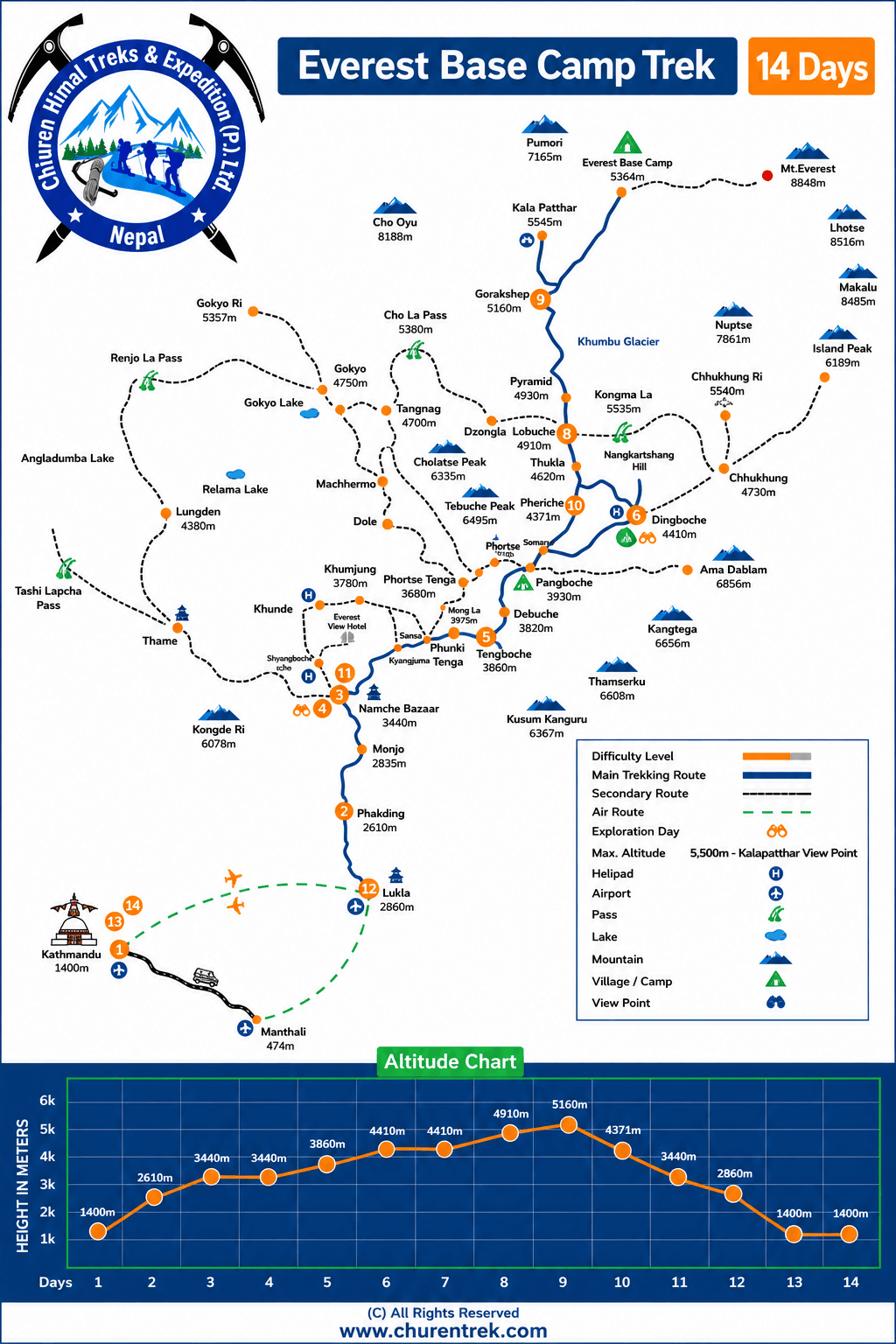
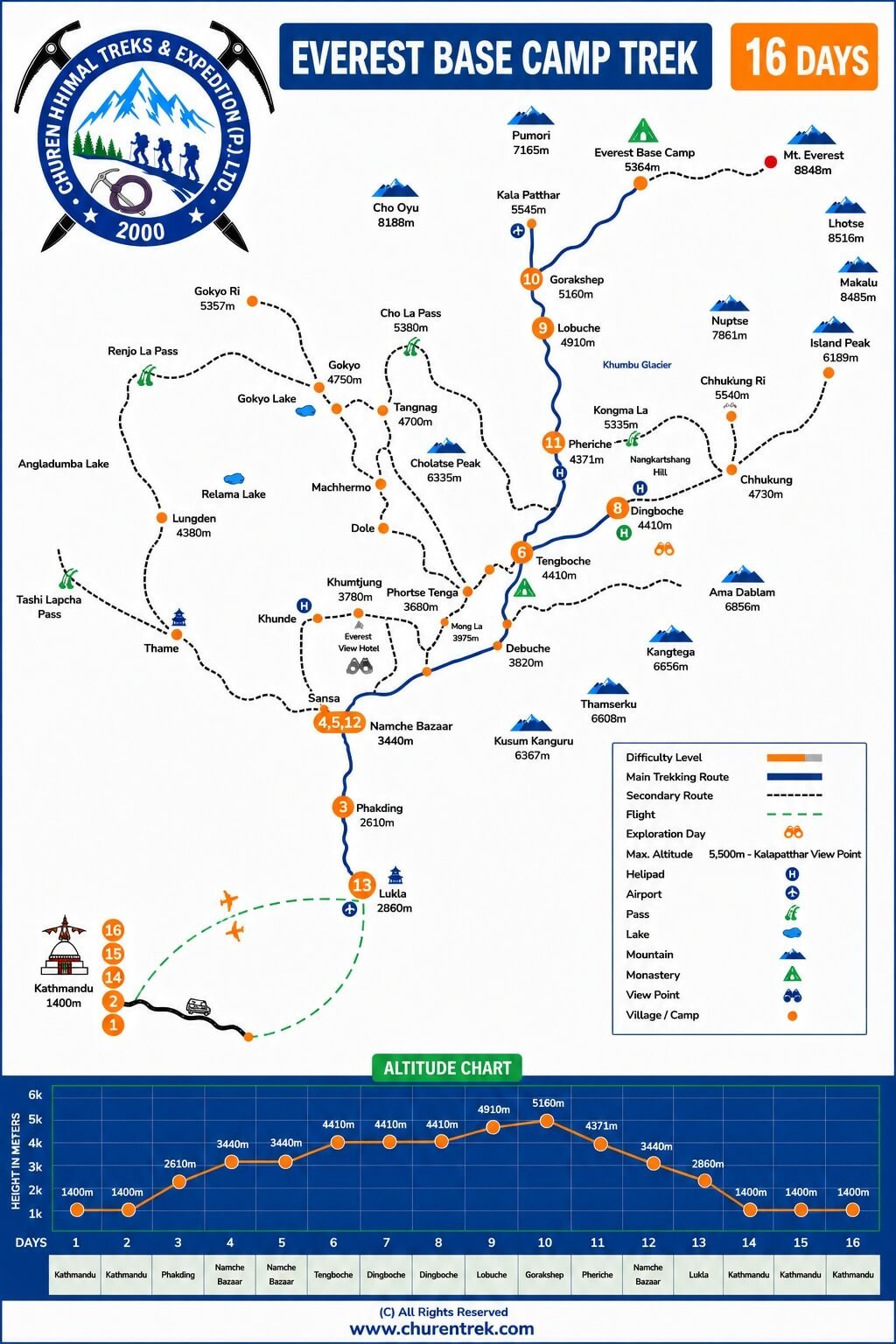
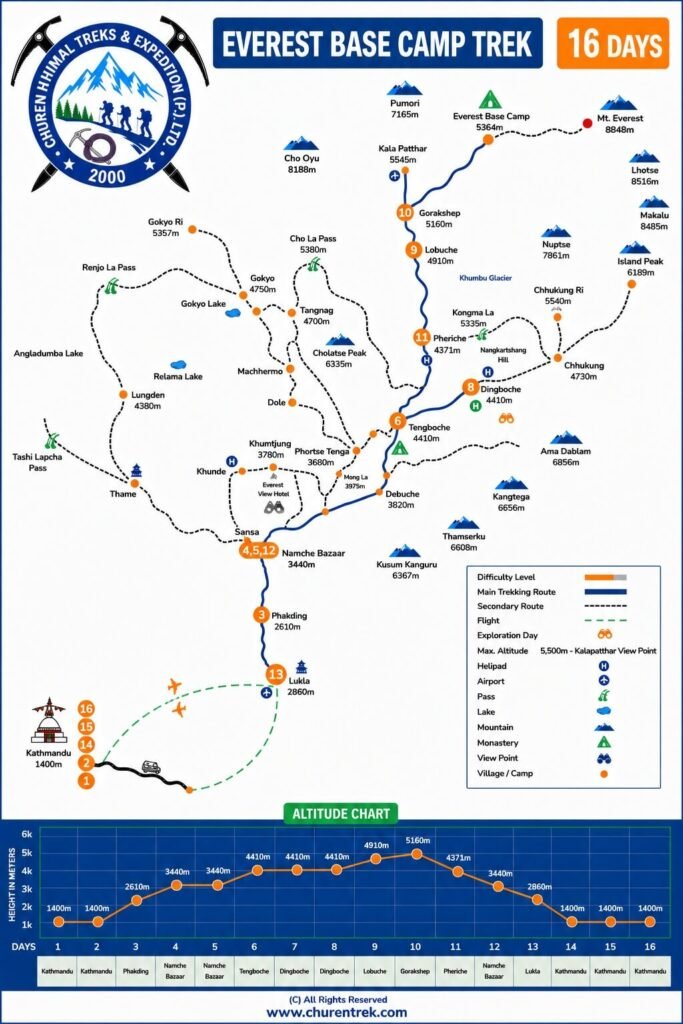
Everest Base Camp Trek Route Map
Everest Base Camp Trek – 16 Days route map
Everest Base Camp Trek Route Map Full Zoom View
Link copied to clipboard!
Price starts US$ 1720
1390 US$

We offer group discount

1 personUS$ 1590
2 peopleUS$ 1390
3 - 6 peopleUS$ 1350
7 - 10 peopleUS$ 1290
11 + peopleUS$ 1190
  • Best price guarantee
  • Secure & easy online booking
  • Flexible booking dates

Speak to an Expert

Sujan
Nepal 🇳🇵
WhatsApp +9779851233710

Everest Three High Passes Trek Highlights

  • Cross Kongma La: Conquer Kongma La Pass, the first and one of the most challenging of the three major high mountain passes on this epic trek.
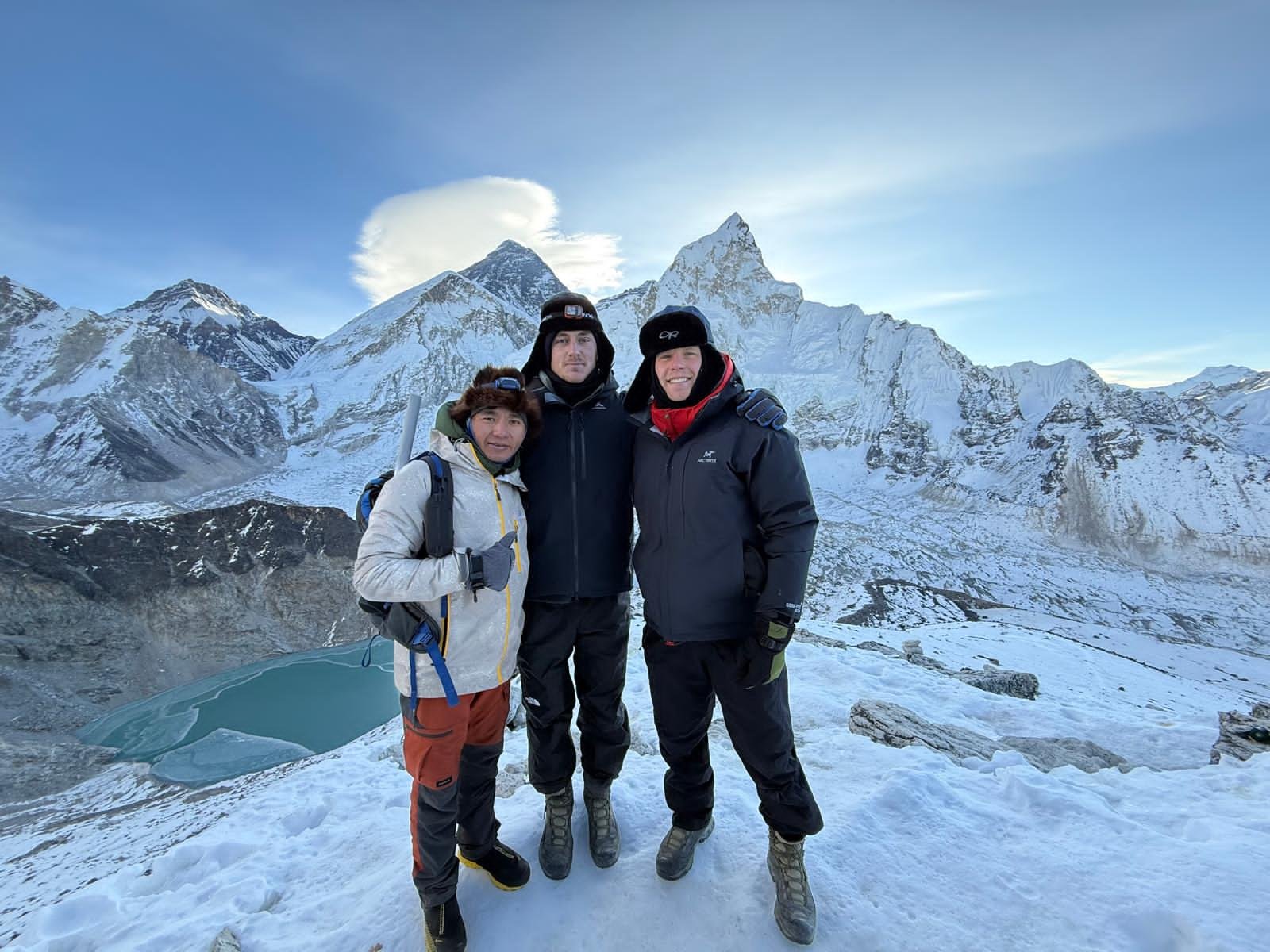
  • Visit Everest Base Camp: Stand at the legendary base camp of the world's highest peak and experience the dramatic Khumbu glacial environment.
  • Hike to Kala Patthar: Climb to the summit area of Kala Patthar for some of the finest panoramic mountain views in the Himalayas.
  • Cross the Dramatic Cho La: Traverse the spectacular Cho La Pass, connecting the remote valleys of Chhukung and Lobuche with Gokyo.
  • Explore Gokyo Lakes: Discover the stunning, crystal-clear turquoise high-altitude sacred lakes nestled under majestic peaks.
  • Climb Gokyo Ri: Ascend Gokyo Ri for breathtaking panoramic views of Everest, Cho Oyu, Lhotse, and Makalu.
  • Cross the Spectacular Renjo La: Experience the sweeping vistas and rugged mountain beauty from the summit of Renjo La Pass.
  • Experience Sherpa Culture: Immerse yourself in the authentic daily life, hospitality, and traditions of local Sherpa communities.
  • Visit Tengboche Monastery: Explore the historic and culturally significant monastery set against an extraordinary backdrop of Himalayan giants.
  • Explore Namche Bazaar: Discover the vibrant principal trading settlement and cultural hub of the Khumbu region.
  • Trek Through Sagarmatha National Park: Journey through a protected UNESCO World Heritage site boasting rich alpine flora, fauna, and dramatic scenery.
  • Explore Remote High-Altitude Valleys: Venture far beyond the standard Everest Base Camp route into pristine, less-traveled wilderness areas.
  • Visit Thame Valley: Explore the historic Thame Valley, deeply associated with legendary Sherpa mountaineering heritage.
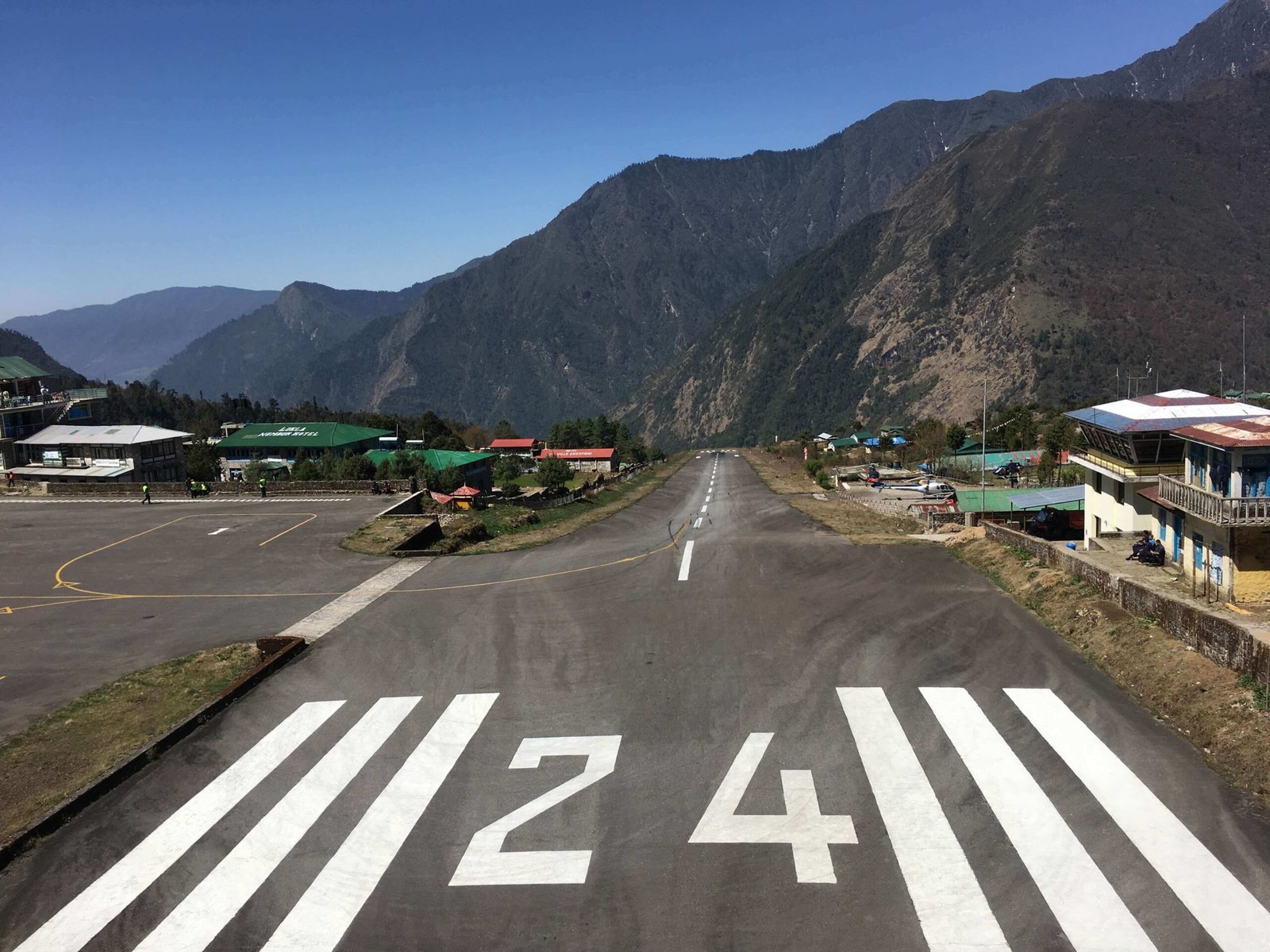
  • Scenic Mountain Flight: Enjoy the thrilling and picturesque flight between Kathmandu and the mountain gateway of Lukla.
  • See Major Himalayan Peaks: Witness awe-inspiring views of world-renowned giants and surrounding majestic Khumbu landscape throughout your journey.

Everest Three High Passes Trek – 22 Days Overview

The Everest Three High Passes Trek – 22 Days is an adventurous high-altitude circuit through Nepal's Khumbu region, combining three spectacular mountain passes—Kongma La, Cho La and Renjo La—with some of the Everest region's most famous destinations. The itinerary also includes Everest Base Camp, Kala Patthar, Gokyo Lakes, Gokyo Ri, Namche Bazaar and Tengboche.

This 22-day itinerary gives trekkers time to acclimatize progressively before tackling the high passes. It combines the classic Everest Base Camp route with quieter valleys and demanding crossings, making it particularly suitable for experienced hikers seeking a comprehensive Everest-region adventure rather than a conventional base-camp trek.

The route reaches several points above 5,000 m, including the three high passes and Kala Patthar. Because of the altitude, long walking days, steep ascents and variable mountain weather, the trek requires good physical preparation and careful acclimatization.

The Everest Three High Passes Trek is one of the more demanding trekking circuits in the Khumbu. Instead of following the same trail to Everest Base Camp and returning, the route forms a broad circuit through the valleys east and west of the main Everest corridor.

The first stage follows the traditional Lukla–Namche–Tengboche–Dingboche approach. After acclimatization around Chhukung, the trail crosses Kongma La to reach Lobuche and Everest Base Camp. A sunrise ascent of Kala Patthar is followed by the Cho La crossing into the Gokyo Valley. After visiting Gokyo and climbing Gokyo Ri, the route crosses Renjo La before descending through Lungden and Thame to Namche and eventually Lukla.

The supplied itinerary deliberately includes a contingency day in Kathmandu before final departure. This provides some flexibility when mountain flights are affected by weather or operational conditions.

Everest Three High Passes Trek - 22 Days Details Itinerary

  • Day 01: Arrival in Kathmandu and Welcome to Nepal
    +

    Arrive in Kathmandu and meet the Churen Himal Treks and Expedition team for airport transfer to your hotel. After check-in and some time to recover from the journey, there is an opportunity to receive a briefing about the trek, equipment and upcoming mountain flight.

    In the evening, the itinerary includes a welcome dinner accompanied by a traditional Nepalese cultural performance. It is a relaxed introduction to Nepal before the high-altitude adventure begins.

    Route: Tribhuvan International Airport → Kathmandu hotel
    Altitude: 1,350 m
    Walking Duration: Not applicable
    Walking Distance: No scheduled trekking
    Elevation Gain (+): —
    Elevation Loss (-): —
    Meals: Dinner
    Accommodation: Hotel
  • Day 02: Kathmandu Valley Cultural Sightseeing
    +

    Use the second day to explore some of Kathmandu Valley's important cultural and religious landmarks. The sightseeing program includes Pashupatinath Temple, Boudhanath Stupa, Kathmandu Durbar Square and Swayambhunath.

    The day provides a cultural contrast to the Himalayan environment ahead. It is also useful for final preparation, equipment checks and ensuring that everything needed for the mountain journey is ready before departure for Lukla.

    Route: Kathmandu → Pashupatinath → Boudhanath → Kathmandu Durbar Square → Swayambhunath
    Altitude: ~1,350 m
    Walking Duration: Sightseeing walking
    Walking Distance: Variable; not counted in trek total
    Elevation Gain (+): Not calculated
    Elevation Loss (-): Not calculated
    Meals: Breakfast
    Accommodation: Hotel
  • Day 03: Fly to Lukla and Trek to Phakding
    +

    The Himalayan adventure begins with a flight toward Lukla, the principal gateway for trekking in the Everest region. Flight schedules are subject to weather and operational conditions.

    After arriving in Lukla, the trail descends gradually through villages and woodland toward Phakding. The first walking day is intentionally moderate, allowing trekkers to begin adapting to the altitude without an immediate long ascent.

    Route: Kathmandu → Lukla → Phakding
    Altitude: Lukla 2,860 m; Phakding ~2,610 m
    Walking Duration: Approximately 3–4 hours
    Walking Distance: Approximately 8 km
    Elevation Gain (+): Minimal overall
    Elevation Loss (-): Approximately 250 m net
    Meals: Breakfast, Lunch, Dinner
    Accommodation: Tea house
  • Day 04: Trek from Phakding to Namche Bazaar
    +

    The trail follows the Dudh Koshi valley toward Monjo, where the route enters Sagarmatha National Park. Suspension bridges, pine forests and Sherpa settlements characterize much of the journey.

    After crossing the river and climbing steadily, the trail reaches Namche Bazaar. The final ascent is demanding because of the rapid elevation gain, but the arrival in Namche marks an important stage of the trek. The bustling mountain settlement becomes the base for acclimatization.

    Route: Phakding → Monjo → Sagarmatha National Park → Namche Bazaar
    Altitude: Namche Bazaar ~3,440 m
    Walking Duration: Approximately 5–6 hours
    Walking Distance: Approximately 10–11 km
    Elevation Gain (+): Approximately 800–850 m
    Elevation Loss (-): Approximately 100 m
    Meals: Breakfast, Lunch, Dinner
    Accommodation: Tea house
  • Day 05: Acclimatization Day in Namche Bazaar
    +

    Today is dedicated to acclimatization rather than progressing to another overnight destination. A short hike above Namche can help the body adapt while providing views across the Khumbu landscape.

    The exact acclimatization walk can be adjusted according to weather, fitness and the group's condition. Spending the night again at Namche is an important part of preparing for the increasingly high elevations ahead.

    Route: Namche Bazaar → acclimatization hike → Namche Bazaar
    Altitude: Namche Bazaar ~3,440 m
    Walking Duration: Approximately 3–5 hours depending on hike
    Walking Distance: Optional; approximately 4–7 km depending on route
    Elevation Gain (+): Optional
    Elevation Loss (-): Optional
    Meals: Breakfast, Lunch, Dinner
    Accommodation: Tea house
  • Day 06: Namche Bazaar to Tengboche
    +

    The trail leaves Namche along a scenic contour route with expansive views of the Himalayan peaks. The route passes through woodland and descends toward the Dudh Koshi valley before climbing again toward Tengboche.

    Tengboche Monastery is one of the cultural highlights of the Everest region. Its elevated setting provides a dramatic mountain backdrop, while the surrounding forest and Himalayan peaks create a distinct atmosphere after the busy Namche section.

    Route: Namche Bazaar → Kyangjuma → Phunki Tenga → Tengboche
    Altitude: Tengboche ~3,860 m
    Walking Duration: Approximately 5–6 hours
    Walking Distance: Approximately 10 km
    Elevation Gain (+): Approximately 400–500 m
    Elevation Loss (-): Approximately 100–150 m
    Meals: Breakfast, Lunch, Dinner
    Accommodation: Tea house
  • Day 07: Tengboche to Dingboche
    +

    The trail descends through woodland toward Deboche before continuing through traditional settlements including Pangboche. As the route moves higher, vegetation becomes increasingly sparse and the surrounding landscape opens into a broad alpine environment.

    Dingboche is an important high-altitude settlement and a strategic stopping point before Chhukung and the first major pass. The increasingly thin air makes pacing and hydration more important.

    Route: Tengboche → Deboche → Pangboche → Dingboche
    Altitude: Dingboche ~4,410 m
    Walking Duration: Approximately 5–6 hours
    Walking Distance: Approximately 10–11 km
    Elevation Gain (+): Approximately 550 m
    Elevation Loss (-): Approximately 100 m
    Meals: Breakfast, Lunch, Dinner
    Accommodation: Tea house
  • Day 08: Dingboche to Chhukung
    +

    A relatively short walking day takes the route deeper into the Imja Valley toward Chhukung. The shorter distance is valuable because the itinerary is entering the high-altitude section where the body needs time to adapt.

    Chhukung sits beneath an impressive mountain amphitheater and serves as the staging point for the Chhukung Ri hike and the subsequent Kongma La crossing. The surrounding peaks and rugged valley terrain make the transition from lower Khumbu to high Himalayan country particularly evident.

    Route: Dingboche → Chhukung
    Altitude: Chhukung ~4,730–4,750 m
    Walking Duration: Approximately 2–3 hours
    Walking Distance: Approximately 5 km
    Elevation Gain (+): Approximately 300–350 m
    Elevation Loss (-): Minimal
    Meals: Breakfast, Lunch, Dinner
    Accommodation: Tea house
  • Day 09: Chhukung Ri Acclimatization Hike
    +

    The day is devoted to an ascent of Chhukung Ri, one of the itinerary's important acclimatization and mountain-view hikes. The climb is steep and should be approached at a controlled pace, particularly because the route reaches above 5,500 m.

    From higher points on the ridge, the surrounding peaks and glacial valleys create a dramatic Himalayan panorama. Returning to Chhukung for another night allows the body to recover before the first major high-pass crossing.

    Route: Chhukung → Chhukung Ri → Chhukung
    Altitude: Chhukung ~4,730–4,750 m; Chhukung Ri ~5,500–5,550 m
    Walking Duration: Approximately 5–7 hours
    Walking Distance: Approximately 6–7 km
    Elevation Gain (+): Approximately 800 m
    Elevation Loss (-): Approximately 800 m
    Meals: Breakfast, Lunch, Dinner
    Accommodation: Tea house
  • Day 10: Cross Kongma La to Lobuche
    +

    The first major pass crossing begins early as the trail climbs away from Chhukung toward Kongma La. The ascent is demanding, with steep terrain and potentially snow-covered sections depending on conditions.

    After reaching the pass, the route descends toward the Lobuche area. The dramatic change from high pass to glacial valley makes this one of the trek's most memorable days. Conditions can be demanding, so the crossing should always be assessed according to weather, snow and the group's physical condition.

    Route: Chhukung → Kongma La → Lobuche
    Altitude: Kongma La ~5,535 m; Lobuche ~4,940 m
    Walking Duration: Approximately 7–9 hours
    Walking Distance: Approximately 10–11 km
    Elevation Gain (+): Approximately 800–850 m
    Elevation Loss (-): Approximately 600–700 m
    Meals: Breakfast, Lunch, Dinner
    Accommodation: Tea house
  • Day 11: Everest Base Camp and Return to Gorak Shep
    +

    The trail continues toward Gorak Shep and then follows the rugged route toward Everest Base Camp. The landscape becomes increasingly stark, with moraine, rock and glacial terrain replacing the greener environments of the lower valleys.

    At Everest Base Camp, trekkers can experience one of the defining destinations of the Khumbu. The route then returns to Gorak Shep for the night. Because of the elevation and demanding terrain, steady pacing is particularly important.

    Route: Lobuche → Gorak Shep → Everest Base Camp → Gorak Shep
    Altitude: Gorak Shep ~5,164 m; Everest Base Camp ~5,364 m
    Walking Duration: Approximately 7–9 hours
    Walking Distance: Approximately 11–12 km
    Elevation Gain (+): Approximately 400–450 m cumulative
    Elevation Loss (-): Approximately 400–450 m cumulative
    Meals: Breakfast, Lunch, Dinner
    Accommodation: Tea house
  • Day 12: Kala Patthar Sunrise and Trek to Dzongla
    +

    An early start takes trekkers toward Kala Patthar, one of the best-known viewpoints on the Everest trekking circuit. The climb is steep at altitude, but clear conditions can reveal an extraordinary panorama of Everest and surrounding Himalayan peaks.

    After returning toward Gorak Shep, the route branches away from the standard Everest Base Camp return path and heads toward Dzongla. The descent provides some recovery from the extreme elevation before the next high-pass challenge.

    Route: Gorak Shep → Kala Patthar → Gorak Shep → Dzongla
    Altitude: Kala Patthar ~5,550–5,650 m; Dzongla ~4,830 m
    Walking Duration: Approximately 7–9 hours
    Walking Distance: Approximately 11–12 km
    Elevation Gain (+): Approximately 450–500 m
    Elevation Loss (-): Approximately 750–850 m
    Meals: Breakfast, Lunch, Dinner
    Accommodation: Tea house
  • Day 13: Cross Cho La to Thangnak
    +

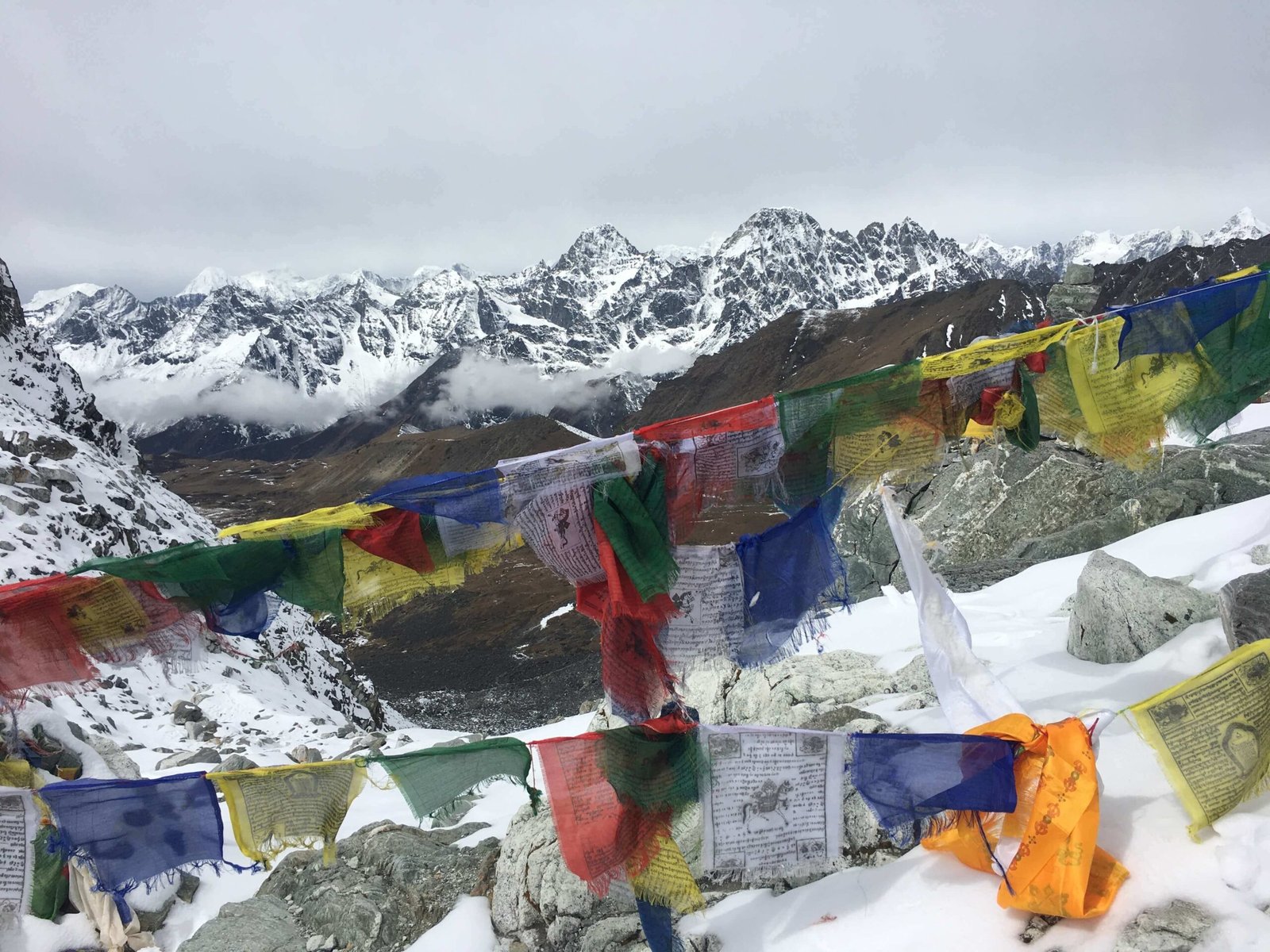
    The second major crossing, Cho La, connects the Everest Base Camp side of the Khumbu with the Gokyo Valley. The trail climbs steeply from Dzongla and may involve snow or icy terrain depending on the season.

    The pass crossing is physically demanding, particularly after the previous days around Everest Base Camp and Kala Patthar. Once across the pass, the route descends toward Thangnak/Dragnag, where a lower overnight elevation provides an important opportunity to recover.

    Route: Dzongla → Cho La → Thangnak/Dragnag
    Altitude: Cho La ~5,420 m; Thangnak ~4,700 m
    Walking Duration: Approximately 6–8 hours
    Walking Distance: Approximately 8–10 km
    Elevation Gain (+): Approximately 600 m
    Elevation Loss (-): Approximately 700 m
    Meals: Breakfast, Lunch, Dinner
    Accommodation: Tea house
  • Day 14: Thangnak to Gokyo Village
    +

    After the demanding Cho La crossing, today's route is comparatively short. The trail follows the high Himalayan landscape toward Gokyo, one of the most spectacular settlements in the Khumbu.

    Gokyo sits beside the famous Gokyo Lakes and beneath a dramatic ring of mountains. The quieter atmosphere contrasts with the busier Everest Base Camp corridor and gives trekkers time to appreciate the high-altitude lake environment.

    Route: Thangnak/Dragnag → Gokyo
    Altitude: Gokyo ~4,790 m
    Walking Duration: Approximately 3–4 hours
    Walking Distance: Approximately 4–5 km
    Elevation Gain (+): Approximately 100 m
    Elevation Loss (-): Minimal
    Meals: Breakfast, Lunch, Dinner
    Accommodation: Tea house
  • Day 15: Gokyo Ri and Gokyo Lakes Exploration
    +

    An ascent of Gokyo Ri provides a major panoramic highlight of the circuit. From the viewpoint, trekkers can appreciate the surrounding high Himalayan landscape and the chain of glacial lakes below.

    The remainder of the day can be used to explore the Gokyo Lakes area according to weather and group energy. This combination of a high viewpoint and alpine lakes makes Gokyo one of the defining destinations on the Three Passes circuit.

    Route: Gokyo → Gokyo Ri → Gokyo Lakes → Gokyo
    Altitude: Gokyo ~4,790 m; Gokyo Ri ~5,350–5,360 m
    Walking Duration: Approximately 4–6 hours
    Walking Distance: Approximately 5–7 km
    Elevation Gain (+): Approximately 550–600 m
    Elevation Loss (-): Approximately 550–600 m
    Meals: Breakfast, Lunch, Dinner
    Accommodation: Tea house
  • Day 16: Cross Renjo La to Lungden
    +

    The final major pass of the itinerary is Renjo La. The trail climbs steadily away from Gokyo and reaches another high Himalayan crossing above 5,000 m.

    After crossing Renjo La, the route descends substantially toward Lungden. The change in elevation and landscape is significant, and the descent can be demanding on the legs after the steep ascent to the pass. Completing Renjo La marks the achievement of all three major high passes.

    Route: Gokyo → Renjo La → Lungden
    Altitude: Renjo La ~5,360 m; Lungden ~4,380 m
    Walking Duration: Approximately 7–9 hours
    Walking Distance: Approximately 10–12 km
    Elevation Gain (+): Approximately 550–600 m
    Elevation Loss (-): Approximately 950–1,000 m
    Meals: Breakfast, Lunch, Dinner
    Accommodation: Tea house
  • Day 17: Lungden to Thame
    +

    The trail continues down the Bhote Koshi valley toward Thame, a historic Sherpa settlement away from the main Everest Base Camp route. After several consecutive days above 4,000 m, the lower elevation provides a welcome change.

    Thame has strong connections with Sherpa mountaineering history and offers a different cultural perspective on the Khumbu. The landscape also feels quieter than the main Everest trekking corridor.

    Route: Lungden → Thame
    Altitude: Thame ~3,820 m
    Walking Duration: Approximately 4–5 hours
    Walking Distance: Approximately 9–11 km
    Elevation Gain (+): Minimal
    Elevation Loss (-): Approximately 550–600 m
    Meals: Breakfast, Lunch, Dinner
    Accommodation: Tea house
  • Day 18: Thame to Namche Bazaar
    +

    The trail leaves Thame and gradually reconnects with the main Khumbu trekking network before reaching Namche Bazaar. The route passes through familiar Himalayan landscapes as the trek begins its final descent toward Lukla.

    Returning to Namche offers an opportunity to rest, enjoy the settlement's facilities and reflect on the three-pass circuit. The hardest high-altitude sections are now behind the group.

    Route: Thame → Namche Bazaar
    Altitude: Namche Bazaar ~3,440 m
    Walking Duration: Approximately 5–6 hours
    Walking Distance: Approximately 10–11 km
    Elevation Gain (+): Approximately 150–250 m
    Elevation Loss (-): Approximately 500–600 m
    Meals: Breakfast, Lunch, Dinner
    Accommodation: Tea house
  • Day 19: Namche Bazaar to Lukla
    +

    The final trekking day follows the route back toward Lukla. The trail descends through the Dudh Koshi valley, passing familiar villages and suspension bridges before the final climb toward Lukla.

    Although the altitude is considerably lower, this is a relatively long walking day. Reaching Lukla completes the trekking portion of the Three High Passes circuit and provides time to prepare for the flight back to Kathmandu.

    Route: Namche Bazaar → Phakding → Lukla
    Altitude: Lukla ~2,860 m
    Walking Duration: Approximately 6–8 hours
    Walking Distance: Approximately 18–20 km
    Elevation Gain (+): Limited overall
    Elevation Loss (-): Approximately 1,500–1,600 m net
    Meals: Breakfast, Lunch, Dinner
    Accommodation: Tea house
  • Day 20: Fly from Lukla to Kathmandu
    +

    After completing the circuit, take the scheduled flight from Lukla toward Kathmandu, subject to weather and operational conditions.

    The flight provides a final aerial perspective of the Himalayan region before returning to Nepal's capital. Once in Kathmandu, the remainder of the day can be spent resting, shopping or relaxing at the hotel.

    Route: Lukla → Kathmandu
    Altitude: Kathmandu ~1,350 m
    Walking Duration: Not applicable
    Walking Distance: No scheduled trekking
    Elevation Gain (+): —
    Elevation Loss (-): —
    Meals: Breakfast
    Accommodation: Hotel
  • Day 21: Kathmandu Free Day and Flight Contingency
    +

    Day 21 is intentionally kept flexible. The supplied itinerary identifies it as a free day in Kathmandu and a contingency day for possible flight delays, which is particularly useful on an itinerary involving Lukla flights.

    If the return flight operated as planned, the day can be used for additional Kathmandu exploration, shopping or relaxation. Keeping this day uncommitted also reduces the risk of connecting an international departure immediately after a potentially weather-affected mountain flight.

    Route: Kathmandu
    Altitude: ~1,350 m
    Walking Duration: Optional
    Walking Distance: Not included in trekking total
    Elevation Gain (+): —
    Elevation Loss (-): —
    Meals: Breakfast
    Accommodation: Hotel
  • Day 22: Final Departure from Kathmandu
    +

    Your Everest Three High Passes adventure concludes with transfer to Tribhuvan International Airport for your onward flight.

    Depending on your departure schedule, there may be time for a final breakfast or last-minute shopping before leaving Nepal. The supplied itinerary concludes with final departure from Kathmandu.

    Route: Kathmandu hotel → Tribhuvan International Airport
    Altitude: Kathmandu ~1,350 m
    Walking Duration: Not applicable
    Walking Distance: No scheduled trekking
    Elevation Gain (+): —
    Elevation Loss (-): —
    Meals: Breakfast
    Accommodation: Not applicable

Cost Includes

  • Airport Pick-Up & Drop : Airport - Hotel transfers – Airport (Pick Up and Drop) by private Car/Van/Bus as per group size.
  • Accommodation in Kathmandu : 4 nights hotel (3-star category) in Kathmandu – Sharing twin Bedroom on BB Plan.
  • Welcome Dinner : 1 complementary Welcome dinner in a typical Nepali restaurant with a cultural program in Kathmandu.
  • Permits : All necessary paper works: Sagarmatha National Park permit, Tims Card and Pasang Lhamu Rural Municipality entry permit.
  • Insurance : Insurance for all involved Nepalese staff during the trek (Guide,Assitance guide,porter & driver).
  • Map : Everest Region Trekking map.
  • Member Transportation : (Domestic Flight) Fly from Kathmandu – Lukla and while returning Lukla – Kathmandu or Ramechhap – Lukla and while returning Lukla – Ramechhap (Private Land Trans.: Kathmandu-Ramrchhao-Kathmandu) as per itinerary.
  • Member Luggage : Up to 14 Kg per member for personal baggage during the trek carrying by porters.
  • Foods & Lodging : Food 3 meals a day (BLD; including tea and coffee) along with accessible accommodation at tea houses/lodges during the trek.
  • Guide : Local government-licensed Guide (English speaking) during the trek and sight-seeing in Kathmandu valley.
  • Porter : A Strong helpful porter with proper equipment (2 trekkers: 1 porter) during the trek.
  • Staff Salary & Allowance : All Nepalese staff & porter’s daily wages, salary, equipment, food & clothing.
  • Valley Sightseeing : Sightseeing in Kathmandu Valley [ Swoyambu (Monkey temple),Boudhanath stupa ,Pasupatinath Temple and Kathmandu Durbar Square] by a professional guide.
  • Medical Kit : Comprehensive Medical kit.
  • Complimentary Services From Churen Himal : Oximeter to check your pulse, oxygen saturation, and heart rate,Daily seasonal fruits for dessert,Churen Himal Duffle Bag for the Trek ,Churen Himal Trekking T-Shirt or Cap, oxygen bottle on hand in an emergency (in group) Satellite phone for emergency.
  • Certificate : Adventure certificate & Token of Love after successful trekking

Cost Excludes

  • International Airfare : International flight airfare (from and to Kathmandu).
  • Nepal Visa Fees : 15 Days – 30 USD,30 Days – 50 USD & 90 Days – 125 USD)
  • Lunch & Dinner : Lunch & dinner during the stay in Kathmandu & Pokhara (also in case of early return from Trekking than the scheduled itinerary).
  • Extra Nights in Kathmandu & Pokhara : Extra nights’ accommodation in Kathmandu & Pokhara. In case of early arrival or late departure, early return from Trekking (due to any reason) than the scheduled itinerary.
  • Insurance : Travel and high altitude insurance, accident, medical & emergency evacuation.
  • Rescue Evacuation : Medical Insurance and emergency rescue evacuation cost if required. (Rescue, Repatriation, Medication, Medical Tests, and Hospitalization costs.)
  • Personal Expenses : Telephone calls, Internet, Toiletries, battery recharge, hot shower, laundry, soft drinks, beer, and any alcoholic beverages.
  • Personal Equipment : Clothing, Packing Items or Bags, Personal Medical Kit, Personal Trekking Gears, etc.
  • Toiletries : Soaps, shampoos, toilet and tissue papers, toothpaste, and other items used to keep yourself clean.
  • Filming : Special Filming, Camera, and Drone permit fee.
  • Internet Service : Internet facility during the trek is not included.
  • Extra Porter : $20 USD for an extra porter per day (If an extra porter is demanded).
  • Tips : Tipping is a culture in Nepal and is expected by your staff (guides, porters, drivers)
  • Extra : Any other services or activities, which are not mentioned in the itinerary. Any other item not listed in the “Cost Includes” section.

Departure Dates

Starting Date End Date Availability Price

Trip Information

Why Choose the Everest Three High Passes Trek – 22 Days?

The principal advantage of the 22-day itinerary is its breadth. It does not treat Everest Base Camp as the only objective. Instead, it connects the Everest Base Camp corridor with the Chhukung, Gokyo and Thame areas to create a much more comprehensive journey through the Khumbu.

The itinerary also provides several opportunities to adapt gradually to altitude. Namche serves as an early acclimatization stop, followed by time around Dingboche and Chhukung before the route reaches the high passes.

For trekkers who want to see Everest Base Camp, Gokyo Lakes and all three major Khumbu passes in one journey, this itinerary offers a logical circuit.

Churen Himal Treks and Expedition Pvt. Ltd. can use the itinerary as a framework and discuss route, dates, support arrangements and practical requirements with individual travelers before departure.

Everest Three High Passes Trek Difficulty

The Everest Three High Passes Trek should be considered a challenging to strenuous high-altitude trekking itinerary.

Its difficulty comes less from technical climbing and more from the combination of:

  • High altitude
  • Long trekking days
  • Large elevation changes
  • Steep ascents and descents
  • Rocky and uneven terrain
  • Pass crossings above 5,000 m
  • Snow and ice conditions that may vary seasonally
  • Cold temperatures
  • Potentially difficult weather
  • Reduced oxygen availability
  • Repeated high-altitude days

Is it a technical climbing expedition?

Normally, the Three Passes Trek is considered high-altitude trekking rather than technical mountaineering. However, pass conditions can change considerably. Snow or ice can make certain sections more demanding, and appropriate equipment may be required depending on conditions.

Who is suitable for this trek?

The itinerary is best suited to physically fit trekkers with previous experience in multi-day mountain trekking or substantial preparation for long, high-altitude walking.

A complete beginner should not assume that fitness alone makes the route easy. The three passes require strong endurance, sensible pacing and an ability to cope with altitude.

People with relevant medical concerns should seek professional medical advice before undertaking a high-altitude trek.

Everest Three High Passes Trek Best Time

  • Spring: March to May: Spring is one of the most popular trekking periods in Nepal. Conditions are generally favorable for mountain trekking, with improving temperatures and good opportunities for mountain views. The later spring period can become warmer and cloudier, while high-pass conditions can still vary according to the winter's snowfall.
  • Autumn: September to November: Autumn is traditionally one of the strongest seasons for trekking in the Everest region. After the monsoon, clearer skies can provide excellent mountain visibility. The principal disadvantages are increased demand for accommodation and flights during the busiest periods.
  • Winter: December to February: Winter brings cold temperatures and potentially significant snow around the high passes. Experienced trekkers may still travel in winter when conditions permit, but pass crossings can become more difficult and route conditions require careful assessment.
  • Monsoon: June to August: The monsoon brings increased rainfall to much of Nepal. Clouds, precipitation and changing mountain conditions can reduce visibility and complicate transport logistics. Because the Three Passes route depends on high-altitude crossings, monsoon conditions should be considered carefully before booking.

Best overall period: For most trekkers, spring and autumn are the most practical seasons, while exact pass accessibility always depends on actual weather and trail conditions.

Lukla flight operations are also weather dependent, so no trekking company should guarantee a particular flight operating in advance.

Everest Three High Passes Trek Permits

The trek passes through the Everest/Khumbu region and requires the applicable trekking and conservation/local permits.

The principal permit consideration is access to Sagarmatha National Park, together with any applicable local-area trekking permit or registration required for the current route.

Permit rules can change, so Churen Himal Treks should confirm the current requirements and fees at the time of booking.

Do not rely on outdated permit information: Older trekking articles sometimes list permit arrangements that have subsequently changed. The final booking documentation should therefore specify the permits currently required for the departure date.

Everest Three High Passes Trek Accommodation

Accommodation follows the normal infrastructure of the Everest trekking corridor.

Kathmandu: The itinerary begins and ends in Kathmandu, with hotel accommodation arranged according to the selected package. The supplied itinerary contains no Pokhara stay, so Pokhara should not be advertised as part of this 22-day itinerary.

Tea houses and guest houses: During the trek, accommodation is generally in locally operated tea houses or mountain guest houses. At lower elevations, lodges may offer relatively comfortable rooms and a broader range of facilities. At higher elevations, facilities become more basic because of the remote environment and logistical limitations.

  • Rooms: Twin-sharing rooms are common on trekking routes, while private rooms may be available at some lodges depending on availability.
  • Bathrooms: Bathrooms may be private or shared depending on the lodge. At higher elevations, facilities can become increasingly basic.
  • Electricity and charging: Electricity and device charging are available at many lodges, but availability, reliability and charging fees can vary.
  • Wi-Fi: Wi-Fi may be available at many tea houses, particularly on more established sections of the route, but connectivity can be slow, intermittent or unavailable in remote/high-altitude locations.
  • Heating: Common areas may have heating, often centered around a communal stove. Bedroom heating should not be assumed.

Everest Three High Passes Trek Food

Meals on the trek are designed around the foods commonly available in Himalayan tea houses.

  • Breakfast: Breakfast options may include eggs, porridge, Tibetan bread, toast, pancakes, potatoes, cereals or similar trekking foods.
  • Lunch: Lunch can include dal bhat, noodles, rice dishes, soups, pasta, potatoes, sandwiches or other locally available meals.
  • Dinner: Dinner commonly includes substantial carbohydrate-based meals such as dal bhat, rice, noodles, pasta, potatoes and soup.
  • Dal Bhat: Dal bhat—rice served with lentil soup and accompanying vegetables—is one of Nepal's most practical trekking meals because it provides a substantial combination of carbohydrates and protein.
  • Vegetarian food: Vegetarian meals are commonly available along the main Everest trekking route, although selection becomes more limited in remote areas.

Hydration: Trekkers should drink regularly throughout the day. Water can generally be obtained from lodges and local sources, but purification or treatment is recommended rather than assuming untreated water is safe.

Hot tea, coffee and other hot drinks are commonly available at trekking lodges.

Travelers with allergies or strict dietary requirements should communicate these requirements before departure and again at lodges.

Everest Three High Passes Trek Acclimatization

Acclimatization is one of the most important aspects of this itinerary because the route repeatedly travels above 4,000 m and crosses passes above 5,000 m.

The itinerary includes a dedicated acclimatization day in Namche Bazaar before continuing higher.

It then allows trekkers to spend time around Dingboche and Chhukung before the first high-pass crossing. Day 9's Chhukung Ri ascent can also function as an acclimatization hike when conditions and individual fitness permit.

Key acclimatization principles:

  • Ascend gradually
  • Avoid unnecessarily rapid gains in sleeping altitude
  • Walk at a sustainable pace
  • Stay hydrated
  • Eat sufficiently
  • Allow your body to adjust
  • Tell your guide about concerning symptoms
  • Do not attempt to "push through" serious altitude symptoms

Possible altitude-sickness symptoms: Symptoms can include headache, nausea, dizziness, unusual fatigue, loss of appetite and disturbed sleep.

Symptoms that worsen or become severe should be taken seriously. The appropriate response to significant altitude illness can involve stopping the ascent and descending, with professional medical assistance where required.

This information is general trekking guidance and does not replace medical assessment.

Everest Three High Passes Trek Packing List

  • Clothing: Moisture-wicking base layers, trekking shirts, fleece or mid-layer, insulated down/synthetic jacket, waterproof/windproof shell, trekking trousers, warm thermal trousers, waterproof trousers, warm gloves, hat, sun hat, buff or neck gaiter, warm socks
  • Footwear: Well-broken-in trekking boots, comfortable camp shoes, trekking socks, gaiters if appropriate for the season
  • Trekking equipment: 40–60 litre backpack, daypack where appropriate, sleeping bag rated for cold conditions, trekking poles, headlamp and spare batteries, water bottles or hydration system, water purification tablets/filter, sunglasses with suitable UV protection, sunscreen, lip protection
  • Health and personal supplies: Personal medication, basic first-aid supplies, blister treatment, personal toiletries, hand sanitizer, prescription medication, small personal medical kit
  • High-pass equipment: Depending on season and current trail conditions: Microspikes, appropriate traction equipment, gaiters, extra gloves, extra warm layers. Whether crampons are actually required should be determined according to current conditions and the equipment recommendation from the guide/operator.

Everest Three High Passes Trek Distance & Elevation Table

The following table is a planning-level calculation, not a GPS survey. Distances and elevation totals can vary according to exact trail alignment, lodge location, side trips and seasonal trail conditions.

Day Trek Approx. km Ascent Descent
3 Lukla–Phakding 8 ~100 m ~350 m
4 Phakding–Namche 10–11 ~850 m ~100 m
5 Namche acclimatization Optional Optional Optional
6 Namche–Tengboche ~10 ~450 m ~100 m
7 Tengboche–Dingboche 10–11 ~550 m ~100 m
8 Dingboche–Chhukung ~5 ~350 m Minimal
9 Chhukung Ri 6–7 ~800 m ~800 m
10 Chhukung–Kongma La–Lobuche 10–11 ~800 m ~650 m
11 Lobuche–EBC–Gorak Shep 11–12 ~430 m ~430 m
12 Gorak Shep–Kala Patthar–Dzongla 11–12 ~480 m ~800 m
13 Dzongla–Cho La–Thangnak 8–10 ~600 m ~700 m
14 Thangnak–Gokyo 4–5 ~100 m Minimal
15 Gokyo Ri 5–7 ~550 m ~550 m
16 Gokyo–Renjo La–Lungden 10–12 ~550 m ~1,000 m
17 Lungden–Thame 9–11 Minimal ~560 m
18 Thame–Namche 10–11 ~200 m ~550 m
19 Namche–Lukla 18–20 ~300 m ~1,600 m

Practical total: Scheduled trail distance: approximately 140–145 km. Optional acclimatization/sightseeing distance: additional and not included in the core trekking total.

Approximate cumulative ascent: around 5,700 m

Approximate cumulative descent: around 7,100 m

Because the route crosses several high passes and includes out-and-back viewpoints such as Everest Base Camp and Kala Patthar, ascent/descent totals are considerably more meaningful for preparation than a single distance number.

Preparation Advice

Physical preparation: Training should begin several weeks before departure and ideally include:

  • Long-distance walking
  • Hill walking
  • Stair climbing
  • Sustained aerobic exercise
  • Strength training for legs
  • Core exercises
  • Back and shoulder conditioning
  • Practice carrying a loaded daypack

The most useful preparation is not simply speed. The ability to walk for several consecutive hours while maintaining a sustainable pace is more important.

High-altitude preparation: No training program can completely eliminate altitude risk. The most effective strategy during the trek is gradual acclimatization, sensible pacing and responding appropriately to symptoms.

Mental preparation: The Three Passes circuit includes days when weather, altitude or terrain may make progress slower than expected. Flexibility and patience are important.

Equipment preparation: Break in trekking boots before departure. Test your sleeping bag, backpack, rain gear and layers before reaching Nepal.

Price starts US$ 1720
1390 US$

We offer group discount

1 personUS$ 1590
2 peopleUS$ 1390
3 - 6 peopleUS$ 1350
7 - 10 peopleUS$ 1290
11 + peopleUS$ 1190
  • Best price guarantee
  • Secure & easy online booking
  • Flexible booking dates

Speak to an Expert

Sujan
Nepal 🇳🇵
WhatsApp +9779851233710

FAQs for Everest Base Camp Trek – 16 Days

FAQs for Everest Base Camp Trek – 16 Days

ℹ️ General

+
➔
What is the Everest Base Camp Trek and why is it popular?
It is a world-famous 14-day Himalayan adventure taking you to the base of Mt. Everest through ancient Sherpa villages and stunning landscapes.
➔
How difficult is the Everest Base Camp Trek?
The trek is moderately challenging, requiring good physical stamina for multi-day walking but no technical climbing skills.
➔
How many days does the trek take in total?
The standard Everest Base Camp Trek itinerary offered by Glorious Eco Trek Nepal takes 14 days in total.
➔
Is prior trekking experience necessary for this trip?
No prior trekking experience is mandatory as long as you are healthy, motivated, and in good physical condition.
➔
Can solo travelers join a group trek?
Yes, solo travelers can join our organized group departures or trek with a dedicated personal guide.

🏋️ Preparation & Fitness

+
➔
Is the Everest Base Camp Trek physically challenging?
Yes, walking 5 to 7 hours daily over steep mountain terrain at high altitudes tests your endurance.
➔
Do I need to train before doing the Everest Base Camp Trek?
Yes, pre-trip physical conditioning makes the journey significantly more comfortable and enjoyable.
➔
How many weeks should I train before the EBC trek?
We recommend beginning cardiovascular and endurance training at least 8 to 12 weeks before your trip.
➔
What is the best way to prepare for the Everest Base Camp Trek?
Focus on aerobic workouts like running and swimming alongside stair-climbing with a weighted daypack.
➔
How can I acclimatize to high altitude faster?
Walk at a steady, slow pace, drink 3-4 liters of water daily, avoid alcohol, and strictly follow our rest day schedules.
➔
How many hours will I walk each day during the EBC trek?
You will walk an average of 5 to 7 hours each day depending on the distance between teahouses.
➔
Can first-time trekkers do the Everest Base Camp Trek?
Yes, motivated first-time trekkers with a basic fitness foundation successfully complete the trek every year.

🪪 Permits

+
➔
What permits are required for the Everest Base Camp Trek?
You need the Sagarmatha National Park Entry Permit and the Khumbu Pasang Lhamu Rural Municipality Permit.
➔
Will Glorious Eco Trek Nepal arrange all the necessary permits?
Yes, our team handles all paperwork and arranges all required permits for you.

🛂 Insurance & Visa

+
➔
Do I need travel insurance for the Everest Base Camp Trek?
Yes, travel insurance is strictly mandatory for all trekkers on this expedition.
➔
How do I get a tourist visa for Nepal?
You can fill out the online pre-visa form or apply directly upon arrival at Kathmandu Airport.
➔
Can I get a visa on arrival at the airport?
Yes, tourist visas on arrival are available at Tribhuvan International Airport for most nationalities.
➔
What should the insurance cover for trekking in Nepal?
Your policy must specifically cover high-altitude medical treatment and emergency helicopter evacuation up to 6,000 meters.

💂 Guides & Support Staff

+
➔
Will I have a guide and porter during the trek?
Yes, our standard trip package includes a licensed local guide and helpful porters.
➔
What are the qualifications of your trekking guides?
Our guides are government-certified professionals trained in wilderness first aid and emergency response.
➔
Do the guides speak English?
Yes, all of our guides speak fluent English to ensure seamless communication.
➔
Will porters carry my luggage during the trek?
Yes, porters carry your main heavy duffel bag so you only carry a small, light daypack.
➔
Is tipping guides and porters expected?
Tipping is a traditional way in Nepal to express gratitude to support staff for their hard work.
➔
Can I trek to Everest Base Camp without a guide?
No, current government regulations mandate that all foreign trekkers must be accompanied by a licensed guide.

🛏️ Accommodation and Facilities

+
➔
What kind of accommodation is provided during the trek?
You will stay in traditional, cozy mountain teahouses featuring twin-share bedrooms and a central heated dining room.
➔
Are hot showers and Wi-Fi available along the trail?
Yes, hot showers and Wi-Fi access cards are available at most teahouses for a small extra fee.
➔
Will I get a private room or have to share?
Rooms are structured as twin-sharing for two travelers, though private single rooms can be arranged upon request when available.
➔
Can I charge my phone and devices during the trek?
Yes, charging stations are available in teahouse dining rooms for a nominal hourly rate.
➔
Are toilets available throughout the trek?
Shared indoor toilets are provided in teahouses, ranging from standard Western seats to traditional squat toilets.

🍲 Food and Drinks

+
➔
What kind of food is available during the trek?
Teahouse menus offer fresh meals like traditional Nepali Dal Bhat, soups, fried rice, noodles, eggs, and pasta.
➔
Are vegetarian or vegan meals available?
Yes, vegetarian and vegan choices are widely available and recommended for optimal health at altitude.
➔
Is it safe to drink the water during the trek?
Untreated tap water is unsafe; always drink boiled teahouse water or use purification tablets/UV filters.
➔
Can I buy snacks and drinks along the way?
Yes, small village shops along the path sell bottled drinks, snacks, and chocolate bars.

🌤️ Weather & Seasons

+
➔
What is the best time to do the Everest Base Camp Trek?
Spring (March to May) and Autumn (September to November) offer clear skies and ideal temperatures.
➔
Can I trek during the monsoon or winter season?
Trekking is possible in winter or monsoon, but involves colder conditions, snow, or rain and potential flight delays.
➔
What kind of weather can I expect during the trek?
Daytime walking weather is typically pleasant, but night temperatures drop below freezing at high altitudes.

🩺 Health & Safety

+
➔
What happens if I get sick or injured during the trek?
Your guide will provide immediate first aid, arrange descent if needed, or summon a rescue helicopter for emergency transport.
➔
How do you handle altitude sickness?
We monitor oxygen levels daily, carry emergency first-aid supplies, and enforce immediate descent if severe symptoms appear.
➔
Are there health posts or clinics along the route?
Yes, basic medical posts operate at Namche Bazaar and Pheriche to assist ill or injured trekkers.
➔
Is the trek safe for solo female travelers?
Yes, Nepal is very welcoming, and trekking with our vetted licensed guides guarantees safety and security.
➔
Do I need to bring medicines for the Everest Base Camp Trek?
Yes, pack personal items like Diamox (for altitude), pain relievers, rehydration salts, and blister treatments.

🎒 Packing & Gear

+
➔
What should I pack for the Everest Base Camp Trek?
Key items include thermal clothing layers, a heavy down jacket, broken-in trekking boots, gloves, and a sleeping bag.
➔
Is a sleeping bag necessary?
Yes, a sub-zero rated sleeping bag (-10°C to -15°C) is essential as teahouse rooms are unheated at night.
➔
Where can I keep my extra luggage during the trek?
You can store non-trekking travel luggage for free at your hotel in Kathmandu before heading out.
➔
What is the luggage weight limit for the Lukla flight?
The domestic Lukla flight weight limit is 15 kg total (10 kg main bag + 5 kg hand carry).
➔
How much weight can a porter carry?
A single porter carries up to 25 kg total, usually splitting weight between two trekkers (12.5 kg per person).
➔
Where can I buy trekking clothes and gear?
You can easily buy or rent all essential gear at affordable prices in the Thamel district of Kathmandu.

💳 Booking & Payment

+
➔
What is the booking process and payment method for the Everest Base Camp Trek?
You can reserve online with an advance deposit via card or wire transfer, paying the remaining balance in Kathmandu.
➔
Is there a cancellation or refund policy?
Yes, we provide flexible cancellation policies clearly outlined in our booking agreement terms.
➔
What currency should I carry for expenses along the Everest Base Camp trek?
Carry local Nepali Rupees (NPR) cash for trail purchases as foreign currencies are rarely accepted.
➔
Can I use ATMs or credit cards during the trek?
ATMs on the trail are unreliable and cards are rarely accepted, so carrying cash from Kathmandu is mandatory.
➔
Are there money exchange services in the Everest Base Camp region?
Money exchange services are available in Namche Bazaar but offer lower rates than Kathmandu banks.
➔
How much extra money should I budget per day during the trek?
Budget roughly $15 to $25 per day for extra personal expenses like hot drinks, snacks, showers, and battery charging.
➔
Can I book the Everest Base Camp trek if I’m traveling with children?
Yes, healthy children can join provided you arrange a customized, slower-paced itinerary for safety.
➔
Should I book the trek well in advance?
Yes, booking 3 to 6 months in advance ensures guaranteed Lukla flight tickets and premium teahouse rooms.

🛫 Transportation & Flight

+
➔
Do you provide airport pick-up and drop-off services?
Yes, private airport pickup and drop-off transfers are included in our package.
➔
How do I get to the starting point of the trek?
You reach the trail's starting point via a scenic mountain flight to Lukla Airport.
➔
Is the flight to Lukla safe?
Yes, Lukla flights are operated by highly experienced mountain pilots who fly only in clear, safe weather.
➔
What happens if my Lukla flight is delayed or canceled?
Flight schedules shift to the next clear day or alternative helicopter rides can be organized if requested.
➔
What is the mode of transportation to reach Everest Base Camp?
After landing in Lukla, the remaining journey to Base Camp and back is completed entirely on foot.
Churen Trek - Mobile FAQs

ℹ️ General

+
What is the Everest Base Camp Trek and why is it popular?
It is a world-famous 14-day Himalayan adventure taking you to the base of Mt. Everest through ancient Sherpa villages and stunning landscapes.
+
How difficult is the Everest Base Camp Trek?
The trek is moderately challenging, requiring good physical stamina for multi-day walking but no technical climbing skills.
+
How many days does the trek take in total?
The standard Everest Base Camp Trek itinerary offered by Glorious Eco Trek Nepal takes 14 days in total.
+
Is prior trekking experience necessary for this trip?
No prior trekking experience is mandatory as long as you are healthy, motivated, and in good physical condition.
+
Can solo travelers join a group trek?
Yes, solo travelers can join our organized group departures or trek with a dedicated personal guide.

🏋️ Preparation & Fitness

+
Is the Everest Base Camp Trek physically challenging?
Yes, walking 5 to 7 hours daily over steep mountain terrain at high altitudes tests your endurance.
+
Do I need to train before doing the Everest Base Camp Trek?
Yes, pre-trip physical conditioning makes the journey significantly more comfortable and enjoyable.
+
How many weeks should I train before the EBC trek?
We recommend beginning cardiovascular and endurance training at least 8 to 12 weeks before your trip.
+
What is the best way to prepare for the Everest Base Camp Trek?
Focus on aerobic workouts like running and swimming alongside stair-climbing with a weighted daypack.
+
How can I acclimatize to high altitude faster?
Walk at a steady, slow pace, drink 3-4 liters of water daily, avoid alcohol, and strictly follow our rest day schedules.
+
How many hours will I walk each day during the EBC trek?
You will walk an average of 5 to 7 hours each day depending on the distance between teahouses.
+
Can first-time trekkers do the Everest Base Camp Trek?
Yes, motivated first-time trekkers with a basic fitness foundation successfully complete the trek every year.

🪪 Permits

+
What permits are required for the Everest Base Camp Trek?
You need the Sagarmatha National Park Entry Permit and the Khumbu Pasang Lhamu Rural Municipality Permit.
+
Will Glorious Eco Trek Nepal arrange all the necessary permits?
Yes, our team handles all paperwork and arranges all required permits for you.

🛂 Insurance & Visa

+
Do I need travel insurance for the Everest Base Camp Trek?
Yes, travel insurance is strictly mandatory for all trekkers on this expedition.
+
How do I get a tourist visa for Nepal?
You can fill out the online pre-visa form or apply directly upon arrival at Kathmandu Airport.
+
Can I get a visa on arrival at the airport?
Yes, tourist visas on arrival are available at Tribhuvan International Airport for most nationalities.
+
What should the insurance cover for trekking in Nepal?
Your policy must specifically cover high-altitude medical treatment and emergency helicopter evacuation up to 6,000 meters.

💂 Guides & Support Staff

+
Will I have a guide and porter during the trek?
Yes, our standard trip package includes a licensed local guide and helpful porters.
+
What are the qualifications of your trekking guides?
Our guides are government-certified professionals trained in wilderness first aid and emergency response.
+
Do the guides speak English?
Yes, all of our guides speak fluent English to ensure seamless communication.
+
Will porters carry my luggage during the trek?
Yes, porters carry your main heavy duffel bag so you only carry a small, light daypack.
+
Is tipping guides and porters expected?
Tipping is a traditional way in Nepal to express gratitude to support staff for their hard work.
+
Can I trek to Everest Base Camp without a guide?
No, current government regulations mandate that all foreign trekkers must be accompanied by a licensed guide.

🛏️ Accommodation and Facilities

+
What kind of accommodation is provided during the trek?
You will stay in traditional, cozy mountain teahouses featuring twin-share bedrooms and a central heated dining room.
+
Are hot showers and Wi-Fi available along the trail?
Yes, hot showers and Wi-Fi access cards are available at most teahouses for a small extra fee.
+
Will I get a private room or have to share?
Rooms are structured as twin-sharing for two travelers, though private single rooms can be arranged upon request when available.
+
Can I charge my phone and devices during the trek?
Yes, charging stations are available in teahouse dining rooms for a nominal hourly rate.
+
Are toilets available throughout the trek?
Shared indoor toilets are provided in teahouses, ranging from standard Western seats to traditional squat toilets.

🍲 Food and Drinks

+
What kind of food is available during the trek?
Teahouse menus offer fresh meals like traditional Nepali Dal Bhat, soups, fried rice, noodles, eggs, and pasta.
+
Are vegetarian or vegan meals available?
Yes, vegetarian and vegan choices are widely available and recommended for optimal health at altitude.
+
Is it safe to drink the water during the trek?
Untreated tap water is unsafe; always drink boiled teahouse water or use purification tablets/UV filters.
+
Can I buy snacks and drinks along the way?
Yes, small village shops along the path sell bottled drinks, snacks, and chocolate bars.

🌤️ Weather & Seasons

+
What is the best time to do the Everest Base Camp Trek?
Spring (March to May) and Autumn (September to November) offer clear skies and ideal temperatures.
+
Can I trek during the monsoon or winter season?
Trekking is possible in winter or monsoon, but involves colder conditions, snow, or rain and potential flight delays.
+
What kind of weather can I expect during the trek?
Daytime walking weather is typically pleasant, but night temperatures drop below freezing at high altitudes.

🩺 Health & Safety

+
What happens if I get sick or injured during the trek?
Your guide will provide immediate first aid, arrange descent if needed, or summon a rescue helicopter for emergency transport.
+
How do you handle altitude sickness?
We monitor oxygen levels daily, carry emergency first-aid supplies, and enforce immediate descent if severe symptoms appear.
+
Are there health posts or clinics along the route?
Yes, basic medical posts operate at Namche Bazaar and Pheriche to assist ill or injured trekkers.
+
Is the trek safe for solo female travelers?
Yes, Nepal is very welcoming, and trekking with our vetted licensed guides guarantees safety and security.
+
Do I need to bring medicines for the Everest Base Camp Trek?
Yes, pack personal items like Diamox (for altitude), pain relievers, rehydration salts, and blister treatments.

🎒 Packing & Gear

+
What should I pack for the Everest Base Camp Trek?
Key items include thermal clothing layers, a heavy down jacket, broken-in trekking boots, gloves, and a sleeping bag.
+
Is a sleeping bag necessary?
Yes, a sub-zero rated sleeping bag (-10°C to -15°C) is essential as teahouse rooms are unheated at night.
+
Where can I keep my extra luggage during the trek?
You can store non-trekking travel luggage for free at your hotel in Kathmandu before heading out.
+
What is the luggage weight limit for the Lukla flight?
The domestic Lukla flight weight limit is 15 kg total (10 kg main bag + 5 kg hand carry).
+
How much weight can a porter carry?
A single porter carries up to 25 kg total, usually splitting weight between two trekkers (12.5 kg per person).
+
Where can I buy trekking clothes and gear?
You can easily buy or rent all essential gear at affordable prices in the Thamel district of Kathmandu.

💳 Booking & Payment

+
What is the booking process and payment method for the Everest Base Camp Trek?
You can reserve online with an advance deposit via card or wire transfer, paying the remaining balance in Kathmandu.
+
Is there a cancellation or refund policy?
Yes, we provide flexible cancellation policies clearly outlined in our booking agreement terms.
+
What currency should I carry for expenses along the Everest Base Camp trek?
Carry local Nepali Rupees (NPR) cash for trail purchases as foreign currencies are rarely accepted.
+
Can I use ATMs or credit cards during the trek?
ATMs on the trail are unreliable and cards are rarely accepted, so carrying cash from Kathmandu is mandatory.
+
Are there money exchange services in the Everest Base Camp region?
Money exchange services are available in Namche Bazaar but offer lower rates than Kathmandu banks.
+
How much extra money should I budget per day during the trek?
Budget roughly $15 to $25 per day for extra personal expenses like hot drinks, snacks, showers, and battery charging.
+
Can I book the Everest Base Camp trek if I’m traveling with children?
Yes, healthy children can join provided you arrange a customized, slower-paced itinerary for safety.
+
Should I book the trek well in advance?
Yes, booking 3 to 6 months in advance ensures guaranteed Lukla flight tickets and premium teahouse rooms.

🛫 Transportation & Flight

+
Do you provide airport pick-up and drop-off services?
Yes, private airport pickup and drop-off transfers are included in our package.
+
How do I get to the starting point of the trek?
You reach the trail's starting point via a scenic mountain flight to Lukla Airport.
+
Is the flight to Lukla safe?
Yes, Lukla flights are operated by highly experienced mountain pilots who fly only in clear, safe weather.
+
What happens if my Lukla flight is delayed or canceled?
Flight schedules shift to the next clear day or alternative helicopter rides can be organized if requested.
+
What is the mode of transportation to reach Everest Base Camp?
After landing in Lukla, the remaining journey to Base Camp and back is completed entirely on foot.
💬

Reviews on Everest Base Camp Trek – 14 Days

🟢 225+ Tripadvisor Reviews 🟢🟢🟢🟢🟢
🌐 118+ Excellent Google Reviews ★★★★★
⭐ Based on 45 Reviews ★★★★★
Verified by Trustindex ⓘ
▶

Video Testimonials

Video Testimonial 1
▶
Video Testimonial 2
▶
🏔️ Churen Trek
▶
Video Testimonial 4
▶
US$ 1390 Per Person